v2 draft as of 20260816
- An Analog Witness
- Phenomenology Of Experience
- How We Consume
- How We Connect
- How We Learn
- How We Live
- How We Work
- How We Create
- Final Transmission
An Analog Witness
I am an analog native, a witness to the digital revolution. I remember what it was like before, and I watched as it broke the old paradigm into a thousand pieces.
We were the last generation to grow up in a world limited by distance. Our neighborhood was small, isolated, contained.
We were the last generation to be untethered by an invisible wire, free to roam anywhere our bikes could go, unreachable, unprotectable.
We were the last generation to grow up without the invisible audience watching our every move. There was a phone in the kitchen and you had to stretch the wire into the dining room to talk so your parents couldn’t hear.
We went to the library to write school papers, because that’s where the books were. We had record collections and photo albums and TV antennas and Pong. We rode our bikes and made up games and played capture the flag on hot summer nights. We drank water from the garden hose and threw eggs at cars and got chased by grownups. Our world was intimate and earthy.
We were there when computers went mainstream and it seemed like the power of a rocket scientist was in your hands. All the data stored on external floppy disks, 1.4 megabytes. I had a Commodore 64. My iPhone has more memory than 100,000 Commodore 64s put together.
We were there for Napster and mp3s and the death of the music industry. These were the opening shots of the digital revolution, the trickle that became the tsunami that would crash on every analog industry. It is still crashing.
It was the dawn of a new era and although we felt it in the air, nobody could have foreseen the artificial intelligence that would displace our ways of life. The dinosaurs are still dying one by one, but the outcome is a foregone conclusion.
My children are digital natives. Their children will be AI natives. In two generations the analog way of life will be a relic of a bygone era, on the same side of history as ancient Rome. The nuances of analog life will be lost. Therefore I feel it is a service to future generations that I preserve the memory while it is still fresh.
Phenomenology Of Experience
Taxonomy
The purest experience is native-analog, that is experience which occurs only in the natural world. The subject, object and nature of the experience all reside within the analog domain. Walking on the beach. Playing the piano. Making love. These can only be experienced in real life.
Digital experiences are virtual representations of analog experiences. They are avatars, simulations of actual things, not things in themselves. An e-book is an avatar of a physical book. A software instrument is an avatar of a real instrument. A zoom call is an avatar of a live meeting.
The fidelity of a digital experience is a function of how faithfully the avatar represents its analog source. For example, we can say that modern virtual instruments are a high fidelity digital experience because they so accurately represent the original thing that trained ears often cannot tell the difference.
But the fidelity of a digital experience is also a function of whether the subject of the experience has any direct prior experience with the analog source, since fidelity implies two objects compared to each other. If I grew up playing real pianos, I hold the experiential authority with which to judge the fidelity of the virtual version of a piano. The virtual piano is a first order digital experience, since I have direct prior experience with the analog source and my brain can connect and compare the two. The digital experience is once removed from the source.
I have never heard of a shakuhachi, but it is available in my sound library under World/ Asian/ Wind instruments. I can select it and record a performance using its sound as a virtual instrument, but I hold no experiential authority with which to judge the fidelity of the virtual version. In this case the avatar is a thing in itself, and the issue of fidelity is a moot point. This is a second order digital experience, since I have no prior experience with the analog source. In this case the digital experience is twice removed from the source.
The deeper we go into digital-first life, a new class of experience is emerging: experiences which are purely digital, i.e. there is no analog reference point because these experiences cannot exist in the natural realm. Native digital experiences are not representations of analog experiences, their nature is self-contained within the experience itself. These are standalone experiences in and of themselves. These are avatars that do not represent anything in the real world. Jumping on blocks in the sky in Fortnite, flying through space in a virtual reality game, another example here. [examples – wizard in a game, casting a spell, virtual reality experiences, fortnite]
Therefore there are four categories of experience:
| Native Analog Experience | Experience which exists solely in the analog realm, i.e. cannot be digitized |
| First Order Digital Experience | Digital representation of an analog experience where the subject has prior experience with the native analog source |
| Second Order Digital Experience | Digital representation of an analog experience where the subject has no prior experience with the native analog source |
| Native Digital Experience | Experience which exists solely in the digital realm, i.e. cannot exist in the natural realm |
The Memory Bank
At birth our memory bank is empty. As we begin to have experiences we accumulate memories. Experiences are deposits into the memory bank. Future experiences derive their meaning and context from prior experiences: as we grow older and experience things, our mind searches and scans the memory banks for matches – images, sounds, smells, feelings, words, voices, colors – any environmental cues that are similar to the current experience which can help the brain contextualize and interpret the new experience.
This mechanism works across all categories of experience:
- Native analog experiences are direct deposits into the memory bank. They are the ore from which all digital experiences derive meaning. Every native analog experience is tagged and cataloged. As we live and move through new experiences, our brain searches the memory bank of previously stored native analog experiences, looking for matches. If there is a match, our interpretation of the new experience is shaped by the saved interpretation of the previous experience. If there is no match, the new experience becomes a fresh deposit in the memory bank with which to interpret future experiences, and the memory bank becomes richer by one entry.
- First order digital experiences derive meaning by matching the avatar against the native analog experience that the avatar represents. The quality and depth of the digital experience is a function of how well the avatar represents the original analog source.
- Second order digital experiences derive meaning by stitching together native analog experiences that are related to the digital experience. Since in this case the subject of the digital experience does not have direct prior experience with the analog source of the avatar, the brain fills the gaps by looking for matches that are relevant or are as close as possible to the avatar, then stitches them together to create a meaning for the avatar.
- Native digital experiences derive meaning by creating a composite structure that is an imagined experience. Since by definition native digital experiences are not possible in the natural world, no analog referent is possible in this case. The brain must create meaning through a generative process of combining multiple native analog experiences into an imagined digital experience, extrapolating from lived native analog experiences to impart meaning and feeling onto the digital experiences. The digital experience is a composite of multiple images and memories from analog experience that my brain has mapped onto the digital experience.
Generational Loss
Analog information is subject to increasing distortion and loss of fidelity with each subsequent generational transfer. Think of a game of telephone, how the original message distorts beyond recognition by the time it gets back around to you. If you wanted to make a copy of an album, you hooked up a cassette deck to your stereo system and played the album through in real time while recording it onto the cassette tape. The cassette copy was a first generation artifact. The album and the tape were both analog mediums; there was no conversion of analog into digital information during the transfer.
Then your friend wanted the album so he borrowed your tape and made a copy of your copy. Then somebody else wanted the album so that person made a copy of a copy of a copy. Each new generation introduced more distortion and loss of fidelity on top of the distortion introduced by the previous generation – we were distorting distortion – so that after three or four generations there was so much distortion that it was unlistenable.
Digital information is not subject to generational loss of fidelity. All of the meaning resides in the digital domain, which is not subject to distortion. Digital data is simply a stream of binary values: one or zero, there is no grey area. The number 153 means exactly the same thing on the second or hundredth digital transfer.
[claude: When the CD digitized music, copies stopped degrading, and the cassette’s generational loss simply ended. the CD made music pristine and infinitely copyable, so the degrading-cassette world ended and the never-degrading-file world began.]
[another type of generational loss in converting analog to digital – brief discussion of resolution, sample rates, camera pixels etc.]
In the early days of the digital revolution, all digital experiences were first order experiences because everyone was an analog native; second order digital experiences were not possible at that point in time because all experience was analog. As time went on and digital natives began to enter the scene, the same experiences that were first order for analog natives were second order for digital natives.
A Spotify thumbnail image of an album is a first order avatar for an analog native, because they had that album when they were younger; the thumbnail image connects to a memory of the thing it represents, and the memory compensates for the fidelity lost in the digital conversion. The same thumbnail image is a second order avatar for a younger person who never owned or held the album. All this person knows about what the album looks like is contained in the thumbnail image. In this case, the Spotify thumbnail is a thing in itself and has no experiential reference to the original object.
Now here is the paradox about generational loss: second order digital experiences are not felt as a loss, even though they are a loss. it’s not felt as loss because second-order means the subject lacks the referent, so there’s nothing to feel the loss against; second-order subject has no referent to compare against, so the loss is structurally invisible to them. And if they are not felt as a loss, are they truly a loss? There is something quietly tragic in a generation that will never miss what it never had
Immersion
Immersion is the highest form of experience. When I am immersed in an experience I am fully present in the moment. We can be immersed in study, work, a task, a thought, a person, an adventure, etc. Transcendental meditation. The flow state of the artist, when time stands still and nothing else exists other than the act of creation. If every moment we could be absolutely immersed in the present moment we would be free of anxiety, worry, fear; like children and animals. For Buddhists immersion is the goal, where everything external ceases to be and you disappear into the moment. Immersion is bliss, nirvana, enlightenment.
Analog and digital immersion are the inverse of each other. Whereas analog immersion anchors you completely to your immediate time and place, digital immersion anchors you to some other time. Sometimes the power of digital immersion is the very fact that it takes you out of your physical time and place. Maybe you suffer in your time and place. Maybe your time and place is unhealthy or violent or depressing or oppressing. Maybe you desperately need to get out of your time and place, and virtual is your only option. I may be bullied in real life but my avatar is a powerful warrior. In these cases digital immersion is a lifeline.
When I play Assassin’s Creed, I become a character in a virtual world: I am an elite level mercenary in ancient Greece, riding my horse around the countryside, infiltrating enemy forts and taking out guards, hopping across rooftops in seaside villages, battling Cyclops and minotaurs inside mythical caves.
I become lost in the virtual world and forget my physical time and place, even my identity; for that hour I am Alexios. The adrenaline I feel sneaking up on the guards and taking them out is the same adrenaline I would feel if I were actually sneaking up on guards in an enemy fort. The sense of peace and calm I feel as I’m riding my horse along the beach with the sound of the waves lapping and the seagulls overhead is neurologically chemically identical to the peace and calm I would feel if I were actually riding a horse on the beach. The rush and fear during the battle scenes is real, as if I were actually fighting for my life.
But I have never been a warrior in a battle in Ancient Greece. So how can I feel like I am, what is the mechanism of that experience? The answer lies in how the memory bank processes experience. I have never been a warrior in a battle but I have been in a fight. I have never been to the Greek islands but I have been to Puerto Rico. I have never [another example here]
So the quality of a digital experience is a function of how well the lived analog experiences in my memory match or relate to the digital experiences in the game. Therefore the more quantity and quality of analog experiences I have in the library of experiences in my life, the higher quality digital experiences I can have, the richer the data set the digital experiences have to work with to construct meaning.
What happens over time and in the aggregate as younger digital natives become increasingly immersed in native digital experiences?
The quantity and quality of deposits into the memory bank will decline and fade away as kids choose native digital over native analog experiences. This phenomenon is both cause and effect: not only does native analog experience thin by virtue of diminished engagement, but over time, digital experience also becomes less rich, since it borrows meaning from the analog memory bank; eventually digital experiences become thin and one-dimensional. A generation immersed in native-digital is drawing on an emptying well. quality is a function of analog library, so as the library empties, quality thins. The central danger is that the analog bank is the meaning-source for everything downstream, and it’s not being replenished.
If I’ve never been in a fight, and never been to an island, and never [third example], playing Assassin’s Creed will not be as immersive and rich for me.
The Inverted Prison
The danger doesn’t stop there. The quality of native digital experiences has gotten so good and so immersive and so seductive, that for younger digital natives the primary reference point for reality can become flipped, where the virtual world is the primary reference point, and the physical world is the secondary reference point. [examples – gaming online with virtual friends in virtual worlds compared to gathering irl]
As we become more immersed in native digital life, we can become locked in an inverted prison that is a symptom unique to digital life. An ordinary prison locks you in; the inverted prison locks you out – of the present moment, of the here and now, where life is actually happening.
Digital experience by definition takes you out of the present moment. Your phone is a portal to another world, away from this one. We experience life through the camera, staging experiences to get the shot instead of fully living them. The gaze of the invisible audience is always looking over our shoulder so we perform for them instead of simply being. The algorithm is optimized to pull us deeper into the feed; but the deeper we go into the feed, the further we drift from real life. Now we are immersed in a time and place that has no connection to analog reality.
Quietly a new habit is forming, a new neural pathway forged by the algorithms: at the first sign of boredom or stillness or discomfort, we reflexively reach for the phone to escape. Digital life has taught us that we should not have to bear any discomfort, and it offers an immediate solution. Every moment of boredom or stillness or discomfort is an inflection point, a fork in the road, an opportunity to dig into the present, or move away from it. Since we are wired to avoid pain, we take the easy way out, so in the moment of decision we choose to escape into the endless feed for immediate relief. Moments string together over days and months and before we know it, there’s a new habit, a new default neural pathway; now we are stuck in the inverted prison and locked out of the present.
Reckoning – maybe cut this
What happens when a generation is stuck in an inverted prison? As the primary mode of experience shifts from native analog to native digital, the consequences manifest at the generational scale: if immersion is the highest human experience, yet depends on a bank of native analog experiences that is thinning, the well that nourishes meaning for all experience is drying up.
[Work this in from claude: the well is drying up, and no one inside it will feel it going; the loss may be uniquely unrecoverable (because it’s invisible to those living it — they won’t know to extract the wisdom]
As the inputs thin out, so do the outputs. Meaning is borrowed, and the bank is running out. Analog immersion thins by depletion of deposits, and digital immersion thins because its depth is a function of what is already in the bank, therefore a thin bank yields a thin digital experience. This doesn’t just mean less immersive video games, it means thinning immersion across all categories of experience.
Immersion is thinning from both directions in a recursive loop: every hour lost to digital immersion is an hour of analog experience not lived → further depleting the analog experience bank → less raw material from which to composite digital experience meaning → less digital immersion → driving us deeper into alternate (virtual) reality to find meaning → and the cycle perpetuates until we have lost orientation of what it means to be human.
At the same time digital immersion offers a lifeline that is not possible in the natural world. Digital immersion offers access to experience otherwise impossible: being an elite assassin in ancient Greece, flying like an eagle, walking on Mars. Second order and native digital experiences let you have experiences the analog world could never offer. The kid who will never climb a real mountain can stand on a virtual peak; the person who will never visit Greece can ride its coastline.
There is a freedom and autonomy in the divorce of the avatar from its original source; there is a power in the native digital experience that is utterly liberating, that is unique to the digital experience. Escapism can be abused but it can also be a lifeline when real life is too oppressive for the soul to bear. In this way virtual reality can be a savior for a vulnerable spiritual reality. That technology offers a new category of intervention that did not exist even one generation ago is a testimony to humanity’s creative capacity to solve for the deepest human needs.
If digital experience both thins immersion and offers a virtual lifeline, what is the final reckoning? Is it worth it? Just because we can, should we? Must we choose, or is there a hybrid reality that optimizes gains and minimizes losses imposed by the new categories of digital experience?
Even though it is still early days in the digital revolution, we can already see that both are true: the losses are real, but so are the gains. We also know by looking at history how this plays out from every other technological revolution or paradigm shift: we always bleed on the cutting edge of progress. But there will always be costs. There is no progress without them.
How We Consume
The Album Experience
You saved up your money from cutting grass so you could go to the record store on the day the new album by your favorite group came out. You were counting the days. When it finally arrived you rode your bike up to the record store and you were there when they opened the doors.
And boom, there it was, featured in a giant display in the front of the store. You rushed over to put your hands on it. You took in your first view of the new artwork, flipping it over and over to look at the front and back. What does it sound like? What new musical adventures await? There were no teasers on Instagram, no video previews, nothing. You had no idea what was inside, which created mystery. Now the artist is posting BTS clips from the studio while they are making the album.
When you finally had your hands on the album it was like getting the golden ticket from Willy Wonka. You raced home on your bike, ran upstairs to your bedroom, closed the door, and now, the ritual of unwrapping.
There is no packaging for streaming files but the album was a physical product. Pierce the cellophane wrapper through the slit in the cover and peel it off. The cover is made of cardboard so it will get ragged over time but today it is in mint condition and you are going to treat it like a precious gem to keep it that way as long as possible. It is smooth and beautiful; there is a tactile dimension to the experience. There is a new album smell like there is a new car smell. Touch, smell, sight and sound – you are going to devour this artifact with all of your senses.
The anticipation was excruciating and so the payoff will be exhilarating. There is a correlation between the waiting and the reward that has disappeared in the digital culture of immediacy.
As you open the album cover you enter the artist’s world. They have invited you to join them on this adventure and the album is your ticket. Here are large, high-resolution photos that have been crafted and curated to tell a story; long before pix and reels flooded our feeds there were only precious few images to process.
Here are lyrics, production notes, who wrote the songs, who played the guitar solos, where the album was recorded. Everything was here and nowhere else. No website. No wikipedia. No social media. No YouTube or visual representation except maybe photos in a magazine. This album was the exclusive portal, which left room for subjective interpretation and placing oneself within the artist’s world.
You carefully remove the disc from the sleeve. You place the disc on the turntable. You lower the needle and wait for the “pop” that confirms the needle has locked into the grooves. You are seconds away from launch.
Finally the opening sounds. Everything is new. You lock in. You play side one all the way through, five songs in about 20 – 30 minutes, reading the lyrics, looking at the photos as you listen, taking it all in. At the end of side one you flip the record over and play through side two, another 20 – 30 minutes. You wouldn’t dream of skipping anything, or only listening to a few seconds of each song; that would simply not enter your mind. Once you put a record on you were committing to the ride. In the album era songs were not meant to be taken in isolation; the context of the album was embedded in the DNA of each song.
Then there’s the sound quality; nothing compares to the warmth and hair of analog tube amplifiers and the smoothness of a continuous sound wave traveling from the grooves in the record to the speakers to your ears.
Your new album now takes its place inside your record collection, your most prized possession. Your collection is carefully and lovingly curated; it grows slowly and methodically; it has now increased by one. Over time it reveals the shape of you; it grows around you like the roots of a tree; it is an expression and an extension of who you are.
Your record collection is your uniform, your badge. It is how people can see at a distance what side you’re on. You are judged by what’s in – and what’s not in – your collection. Someone can size you up quickly by looking at your collection: are they in my tribe?
The Access Economy
We have shifted from ownership to access. In the analog era we lived within the paradigm of ownership: you owned individual albums. In the digital era we live within the paradigm of access: we lease access to all music. The access paradigm is almost the inverse of the ownership paradigm. Each has costs and benefits, and the costs are not always obvious in the moment.
Owning a physical copy of an album was subject to real-world logistical constraints: manufacturing, shipping, distribution, retail stores. Record labels had to compete for strategic product placement within the record stores. Your options as a buyer were limited to the copies that were available in the store where you lived. If you were a kid in a small town or rural area, there wasn’t even a record store; you had to buy your albums at WalMart and they only carried the top 10. This degree of limitation is inconceivable to the digital native; unlimited access would have been inconceivable to the analog native.
It’s not only music that the digital revolution has made accessible. Movies, books, images, videos, artwork. College courses, historical documents, scientific research. Any media that can be digitized is accessible anytime from anywhere. The digital wave has eliminated the access issues inherent to analog distribution logistics, along with the revenue model upon which those pipelines were built, i.e. traditional media publishing, record labels, etc.
The digital music fan has lost: the anticipation, the ritual of the album experience, the subjective interpretation, the collection as expression. But the digital music fan has gained: universal access. With universal access, you can explore with abandon. Sample anything, everything. Listen to ten seconds of obscure Brazilian-Afro bossa nova jazz. Every day is a voyage of discovery, where one artist leads to another, neither of which you would have known about under the analog model. The world at your fingertips, for the taking. The sense of scarcity and curation: gone. The liberation is intoxicating! You would have never heard this artist on the radio, much less would your record store have a copy that you could buy. Your world has expanded exponentially, and this will affect every aspect of your life: your identity, your career ambitions, your sense of what is possible in life.
Your tribe is bigger, the chances of finding your people expanded globally. No longer must they be in your town. This is unquestionably a net positive. The liberation from analog constraints and the freedom of the access economy is woven into the digital zeitgeist and is expressed through every thread of the fabric of the digital culture: how we work, how we live, how we connect – all aspects of culture have been fundamentally up-ended in the digital revolution.
Ownership is almost a liability in the digital era. Ownership ties you to a place, it ties you down; ownership represents tradition and limitation. The American dream was to put down roots and grow in place; core values were security and stability. Millennials saw their parents devote their lives to the company, then get downsized. 911. Covid. Unthinkables become reality. Security is an illusion. Life is short. Fuck all that. We want quality of life and personal days and unlimited PTO and work from home, work from anywhere. We don’t want a house and a mortgage and a record collection and a job we’re going to die in. We want to be a digital nomad in an RV and work from the beach with our laptop and access to every file ever created.
These are shockwaves from the digital revolution and represent a fundamental cultural shift in how we live and interact in the world today. We would rather subscribe – month to month, cancel anytime – than be strapped to the care and feeding of ownership. Spotify, Netflix, Uber and AirBnb – these are all expressions of the access economy paradigm. The losses are hard to quantify and they are not as obvious as the freedoms offered by the access economy. So digital wins, and the world is transformed, slowly but surely as analog natives cycle out and digital natives replace them.
What are the big picture cultural implications? The access paradigm starts with albums and music; it extends to movies, cars, and houses. Where does it end; what about relationships, are those interchangeable as well? Swipe right. What about going deep on a craft or a discipline? As long as you can make the reel you don’t need to actually do the thing. Where does that lead us in a hundred years?
The Endless Feed
When the record is over, it stops playing. A book has a beginning, a middle, and an end. The analog world has boundaries. Buildings have walls. Yards have fences. States have borders.
The digital world is infinite – never ending, never beginning – we are eternally in the middle of the stream. The digital experience removes the sense of completion and of orientation, where we are in relation to the boundaries. We can scroll forever, like drifting in the ocean with no land in sight.
This is a new type of cognitive load that happens where you never feel finished. Everything is open and nothing is closed. Email inbox is flooded with unread messages and will never be empty again. You try to keep it clean but the effort is futile, like bailing water out of a sinking ship. The digital gravity wears on the soul.
The endless feed doesn’t only remove boundaries, it also removes agency and self-direction. You chose what album to play, what book to read; the algorithm decides what you’re going to see next. Your role in the decision has been stripped down to swiping up or not, whcih does curate the algorithm, but it is the algorithm that defines your options.
But the same algorithm enables a kind of serendipitous discovery that analog scarcity did not allow. Through the act of scrolling and clicking you stumble upon an idea, an artist, a community you didn’t know existed, you could not have found via search because you didn’t know to look. But suddenly – here is the missing piece; here is a magic spark; here is a collision of two ideas that would never have come together in the analog world; here is the idea that plants a seed that will become your next eureka. This kind of cognitive and creative expansion is not possible in linear, analog mediums.
Now here is the recursive issue: the endless feed also changes how content is produced. The album producer knew they had our attention for a block of time, they knew we would stay on a journey at least through one side. This allowed time and space to stretch out, to experiment, to push the boundaries.
The digital era producer has no such luxury. The difference is so very extreme. If you don’t grab the user within a second or two, you lose them. In response the digital native has developed an exaggerated ability for rapid context switching, from one extreme to another in a matter of seconds. Our nervous systems were not built for this.
The endless feed forces content producers to sacrifice depth for engagement. Engagement means revenue; so digital producers optimize for engagement metrics rather than to challenge the audience or reward them with a deep experience. Cultural output in the aggregate becomes disposable. We are swimming in a shallow sea of crap.
Horizontal Reading
You scroll through the feed, not reading, but more like scanning for something that grabs you, something that arrests the process of scrolling. Content producers – we can’t call them authors – optimize images, videos, and headlines to seize your attention; it is a violent transaction, there is force and manipulation involved, versus the graceful and voluntary engagement when you choose a book. It’s more like the content producers are fishing for your attention; you are the prey.
When they hook you, you click in. You tune in to the next level, you assess whether this is something that deserves attention. Still you are not reading, you are reacting instinctively, in a fraction of a second. If you make it all the way to an article or a longer post, now you start to do something that feels a bit like closer to reading but still you are on the surface, still not committed, still looking for any reason to bounce because the gravity of all the unread posts further down the feed are always pulling on you and calling you back to the feed.
An hour later you have floated over the top of hundreds of posts, you’ve clicked a few, you’ve read really nothing. You’ve retained nothing, learned nothing, nothing to show for the time invested. You do not have a relationship with any of the material that you read horizontally, it does not become a part of you for recall of wisdom later. It’s like junk food that is not nourishing. It’s empty cognitive calories. You’ve bookmarked a few articles to read later when you have time, but you later never comes. Like unread emails, the unread bookmarks weigh on the soul as the digital clutter piles up in our minds.
Horizontal reading is a new literacy skill for the digital age: we skim quickly across the top, touching down lightly on each topic or post, then decide from a sample if we want to click in and dive deeper. In this way we cover more ground on the surface at the cost of depth.
The rapid context switching is unique to media consumption in the digital age; one could never switch from book to book so fast. If you could teleport a 17th century reader into 2026 they would find the tempo insane and unnatural; the fact that we have adapted to it is an indictment of what we are willing to give up to gain breadth at the expense of depth. This is not necessarily a healthy or optimal mode of consumption but it is a necessary digital literacy skill.
Research suggests that sustained attention in digital environments has become increasingly fragmented due to notifications, multitasking, and constant digital stimulation. Cognitive scientist Gloria Mark has found that average periods of focused attention during computer-based work have declined substantially over the past two decades, from 150 seconds in 2004 to 47 seconds in 2023. Citation >
Deep reading was an experience investment, and was rewarding like deep listening to an album experience. The pages of the book, this physical artifact that you can touch, hold, and smell the pages, it is a sensory experience like the physical album. This book is a passport to another world. The book is a magic seeing stone, a portal that connects the author’s mind and hand directly to your brain, across time and space. You feel the author is speaking directly to you. There are no comments and no invisible audience; it’s just you and the author, a private party.
A book is a journey that you never forget, it’s an adventure that becomes a part of you. It has its own memories. It changes you in ways a social media post cannot. When you hear a song from years ago, it takes you back to that time and place; that time and place are alive in your memory. A book does the same thing.
Losing the art of deep reading is not a casual loss; it is a symptom of a digital culture that manifests as a lost ability to learn deeply. Deep learning is a critical skill for an elevated and sophisticated civilization. If deep reading and deep learning are lost, deep writing and deep thinking are next. Young people will inherit the world, yet they are losing the ability to sit for 500 pages; they will need the ability to hold large and complex ideas over time and apply advanced cognitive frameworks. How can we solve for humanity’s greatest challenges and build for the future if we have lost the ability to sit for 500 pages? If we lose the ability to learn deeply, our civilization degrades over time and our species is lost.
The Gravity Of Options
How We Connect
The Collapse Of Distance
Signal beacon towers placed along the Great Wall of China relayed messages from one end of the wall to the other. Each tower had line of sight to the next. Smoke signals by day, fire by night. The messages were coded, for example a certain pattern of smoke could indicate the size of an invading army. In this way information travelled across great distances in a matter of hours, much faster than a messenger by horse. This was the first long-distance network.
Communication is simply the transmission of information from a sender to a receiver. All animals can do this. Plants can do this. We could argue that all matter and energy in the universe can do this, for example the transfer of heat energy between objects is essentially a form of communication comprising a sender, a receiver, a medium, and a message (the energy).
But the capacity for complex and abstract communication is unique to humans. It is one of our greatest superpowers. This is how we learn as a species and elevate from one generation to the next, each generation building on the wisdom of the generation before. No other animals can do that. We exchange advanced cognitive concepts – math, science, art, philosophy; what might happen tomorrow based on what happened yesterday; cultural stories, myths and religions; how to build, how to grow crops, how to govern, how to fight. There is no civilization without communication.
Although the essential function of communication has remained the same through the ages from smoke signals to DMs, the modes of communication have changed, and these changes have implications on how communication shapes our lives.
In the ancient world the speed and reach of communication was limited by physical proximity. Whether face to face or through a messenger, communication required co-location in time and space. If the physical connection between the two parties was broken, communication was broken. Realtime dialogue over distance was impossible. Battles lost and empires fell due to slow communication. A Roman emperor would wait weeks for news from the frontier. Napoleon might have won at Waterloo if he had SMS with his generals.
500 years ago the printing press eliminated the need for co-location. Communication no longer required two parties to occupy the same time or place. Now an author could speak to the public through books, pamphlets, or newspapers. This was the birth of mass media. Reach expanded exponentially but the tradeoff was the reciprocal flow of information; this was not a dialogue; mass media is a one-way push.
In the digital age, all barriers to communication are gone. We are not constrained by time, place, or medium. We have two-way interpersonal communication capability with every other person in the world, regardless of where they are, immediately and in realtime dialogue. And like all progress, there is a cost.
The Avatars Between Us
Digital technology connects the world. But it is not connecting people, it is connecting digital representations of people, connecting avatars to each other. My avatar is not me, it is a virtual representation of me. As creator of my own avatar, I have full creative license. I can be whoever I want to be in the virtual world. There are no laws or societal norms dictating how much my avatar should accurately reflect my embodied self. I can be strong, powerful, smart, bold, powerful, good, evil; whatever I want to be in the virtual world. Therefore our avatars do not necessarily reflect who we really are.
- The divorce of the avatar from the person is a defining characteristic of connection in the digital age.
Where we have expanded the surface area of connection, we have created a paradox: engaging in “social” media is a solitary act. You do it by yourself, alone in the dark, through a digital screen. We’ve never been more connected and never more alone. We are connected but also separated by the analog/ digital boundary on both sides: you > your avatar <> their avatar > them. We are connected in real time yet four digital generations removed.
This is a one-dimensional experience, engaging only limited sensory interaction. Interpersonal communication is a total body experience engaging multiple senses – hearing, seeing, smelling, feeling, touching. Most of the meaning is around and below the words, the non-verbal cues, the body language, vibes, and pheromones.
Communication through avatars is connecting but in another way is isolating, and leads to the atrophy of interpersonal social skills. Negotiating the awkwardness of eye contact, learning the art of conversation, articulating feelings, holding space, enforcing boundaries, giving and receiving compassion – these are the arts that can only be practiced within the aura of another embodied person. When most of our communication occurs behind an avatar behind a screen, the skills of interpersonal communication will atrophy, or fail to develop. We now have a generation of young men who struggle to maintain eye contact or hold themselves with poise and confidence in a room.
So although digital technology has removed the constraints from every mode and channel of communication, the shadow of that progress is a corresponding social isolation that is new in history. Here is the inverse correlation between technological and cultural sophistication.
[Avatars of intimacy – ai companions – tinder/ hinge – replika – virtual BF/ GF – joy for all – porn]
Asynchronous Mode
Modes of communication are moderated by protocols, etiquette, and social norms of the age. For example, it is rude to interrupt people when they are talking. With analog modes of communication, I have to be physically near you to interrupt you – to approach you, to knock on your door, to get your attention. Therefore the volume and frequency of interruption is moderated by natural properties of time and space.
Digital networks have removed those analog constraints so that now every channel is open and access is universal; all the gates have come down yet still interruption is permitted in the form of calls and notifications. This is a residual feature of analog life that has not yet cycled out of cultural norms. The rules of communication need to be adjusted to account for universal digital access.
Today I can still pick up the phone and call anyone else that has a phone. This is an outdated mode of communication. When the telephone was invented, the idea that I can have a synchronous conversation with someone in another town was groundbreaking. But that innovation emerged into a world that was not already saturated with connection and exhausted from noise. The idea today that you can connect to a device in my pocket and summon me to an interaction whenever you want is anachronistic. It presumes that whatever you want is more important than whatever I am doing.
When device connection was limited to analog networks, the intrusion factor was at an acceptable level. But when every digital device can access every other digital device, now the possibility for unlimited intrusion is created, and exploited; now you have robocalls and spam. The digital era needs a new kind of gate that accounts for unlimited access. Digital life needs new protocols, and those are asynchronous mode and permission-based access.
Asynch mode fixes the misalignment by placing the timing of the response back in the hands of the receiving party. Asynch solves the unlimited access problem entirely. No longer do both parties need to be available in realtime. I send a message, you answer when you are able. This could be an email, a text message, a voice message, a video message. The defining characteristic is that the receiver does not have to be available in realtime, or in close proximity.
In the digital era asynchronous messaging works for the majority of communication needs. If communication is time sensitive or truly important, realtime messaging channels can be used. But most messages are not time sensitive or truly important. Using realtime channels when a message is not urgent is the boy who cried wolf in the digital age; it’s a new kind of rudeness and violates digital etiquette.
In the digital era, professional communications should be 80% asynchronous. Only about 20% of the work flow requires synchronous mode, and most of that can be handled remotely. Only a small portion of the total workflow needs to be synchronous and co-located (irl).
The downside of asynchronous mode is that unread messages weigh on the soul. It feels like you are accumulating garbage that you never asked for, like someone else forced a bunch of crap into your garage without your permission. You can delete but that still requires effort that someone else forced upon you because they found their way to your inbox. The fix for this is opt-in across the board: you can’t text/ call/ email/ message me unless I accept you as a sender. That fixes the access problem, and now we have the best of both worlds.
Private Life Goes Public
As social animals it is in our DNA to want to belong; survival depends on belonging. So the need to be socially accepted – to be liked – is not mere vanity; it is a matter of life and death as far as the amygdala is concerned.
But the inner life is also a sacred place; the family, the home, the tribe; there has to be a place where we feel accepted unconditionally and free of judgment. The rise of social media populated with the infinite, faceless, disembodied masses of avatars threatens the safe space and blurs the boundary lines, the result of which is a pervasive underlying anxiety about whether there is any place left on earth that is truly safe. There is now a sense that the camera is always on and the audience is always watching; now the world can witness my every move, hear my every thought; not only witness, but judge; not only judge, but condemn. It is layer stacked upon layer of social pressure.
Has the fishbowl effect of social media eroded our ability to have inner dialogue that is fully detached from the external critic? Are we still able to journal with freedom, secure in the knowledge that no one will ever read this, or has the fear of how this would be received, and of whether this will somehow be visible on the cloud, infected our private thoughts? The audience is present as editor before the thoughts even hit the page; we are like a naked actor on the stage who is blinded by the lights and cannot see the audience. Has the digital age corrupted the concept of privacy through moments staged to look private but optimized for engagement?
A couple expecting their first child livestreamed the moment they received test results that their baby had Trisomy 21, a genetic disorder that strongly correlates to Down Syndrome. When the husband read the results, his wife broke down in agony, crying and deeply distressed. But they were livestreaming, and his attention was on the audience; in that moment he was there for the audience and absent for his wife.
Who does the external voice belong to? This is the most tragic part; the voice is the anonymous horde that is social media – the trolls and haters and incels and wounded souls hiding behind avatars and unleashing their aggression, safe behind by computers and screens and ones and zeroes. If the critic was in the same room, if they were co-inhabitants of our world, we could negotiate; we could fight or make peace, we could come to a resolution. In the digital realm all remains unresolved.
If we feel that there is no longer a private safe space in the world, this is a dangerous disorder. The soul must have its refuge. If it doesn’t, we see the effects as an underlying unease, an idiopathic anxiety, depression, OCD or other emotional disturbance. These disorders are not spontaneous. There is always a cause. We cannot expect to fundamentally alter the psychological landscape without consequence any more than we can expect to alter the genetic code without consequence.
- The digital age has caused a shift in the focus of consciousness, from internal to external.
The comparison trap is part of the human condition; the grass is always greener on the other side; thou shalt not covet, etc. It is easy to fall for the idea that your life sucks compared to everyone else because you can’t see the things that suck about everyone else’s life. The new problem is that social media amplifies the effect by exponential orders of magnitude. Now you have eight billion examples of how your life sucks.
The issue is compounded by the fact that the devices, apps, and algorithms are optimized for engagement, one might even fairly say optimized for compulsion or addiction. The algos are perfectly tuned to keep the user feeding on the endless drip of dopamine.
All of this creates a perfect storm for young people who are not yet strong in their identities or ego defenses. Impressions are heightened at this age, as bodies are awkward and changing, and we’re not sure yet where we fit in the world. Everything is still forming – the prefrontal cortex, identity, self-concept – and just doesn’t stand a chance against the endless feed of artificial successmaxxed reality. The fragile boundaries are no match for the sheer volume of content that seems to confirm they are not good enough. It can push them under, into depression, anxiety, self-harm; they can feel lost and hopeless, and this is the tragedy of social media.
[stats or graph of anxiety/ depression in youth correlated with rise of smartphone usage and social media – see claude]
It is easy to blame the parents for letting their kids have unlimited access to the internet, to phones and social media. But GenX parents, as analog natives, were not aware of the damage until it was too late. Nobody knew, not even the creators of the technology itself. Parents were worried about their kids going out, drinking and driving, getting into trouble; they didn’t realize there was a hidden danger we were letting into the homes through the digital screens.
But at this point we have a few years of data, and today GenZ and millennials are starting to take control of their mental health and pushing back against the default mindless device usage. They are bricking their phones or getting dumb phones, deleting social media apps, and consciously limiting screen time in an effort to reclaim analog experiences and relationships. This is a work in progress and everyone is doing the best they can.
The Global Village
These are comments on a TikTok post about laying awake at 4:00 am with ruminating thoughts about not getting a message back from someone:
- You know I find comfort in knowing I’m not the only one who’s feeling lost and lonely right now I’m glad that i have all of you rn.
- I feel so fucking alone like I’m surrounded by people but I could scream at the top of my lungs and nobody would bat an eye, just want to be needed by someone.
- You ever feel like.. Void?
- tik tok knows when I’m sad…
- I think I’ve been here, like in this world, for longer than I was meant to be
- I’m unlovable
- I feel like this feeling will stay with me forever, it has been like this my whole life, is getting difficult to go on, very difficult
- nie mam się do kogo odezwać (I have no one to talk to)
Responses:
- Right here with you 🫶
- im here with you
- I appreciate you
- ♥️
- i’ve been there. hang on tight bud
- Me too hun. It’s like we’re invisible.
This is technology at its best, fulfilling its most noble purpose: connecting people who need each other in a dark moment when they need it most. We shudder to think how some of these people would fare if not for these connections; some would not make it. It is not an exaggeration to say TikTok is saving lives. As a species it is not acceptable for anyone to feel so alone in a world of eight billion people. Technology has a solution.
The connections cut across time zones, national boundaries, cultural identities, ideologies, religions, and socio-economic profiles. These are just people searching for and finding solidarity, the same way we do in our local communities. The difference is that now the village is global. You are no longer limited to your back yard. The algorithm unites you with your tribe, no matter where they are. Here are the receipts >
As a child my world was small: my family, my friends, my neighborhood. Other cultures were abstract representations in encyclopedias. I could no more connect with a child from another culture than fly to the moon.
Our biology is calibrated to an analog world constrained by natural limitations: time, distance, geography, topography. Oceans and mountains and deserts separated the tribes of our ancestors. Cultures were isolated. The nation state was an extension of the tribe, which was an extension of the family. The mixing of cultures was limited by natural constraints: a ship traveling to another port, a messenger traveling by foot or by horse, a caravan of migrants seeking refuge from war or famine. Physical traits and cultural differences expressed their time and place.
Distance collapses in the digital world as information travels at the speed of light, eliminating altogether the limiting factor of physical distance. And since we can now exist virtually through an avatar or a digital agent, in the span of two generations we have gone from occupying one place at a time, to being everywhere at once; people and cultures are mashed together into a digital global village.
Culture is handed down through the generations, and accepted without question. But there is an unspoken, false correlation that needs to be questioned, the idea that the time and place and people into which I was born are necessarily the right time and place and people for me. They may not be. In fact there is probably much about the time and place and people we are born into that isn’t a good fit for our authentic selves. But for some reason that to question it is off limits, like you are questioning identity itself.
Well, yes we are questioning identity itself, and why not? The digital revolution opens up new dimensions of opportunity to find other people and places that may be more of an authentic fit; it opens our minds up to the point where questions like this can occur to us at all.
The idea that our “people” are authentically those that we are born into is a false analog default. I did not choose my culture or my tribe any more than I chose the color of my hair or eyes. The culture in which I was raised was a default function of the time and place into which I was born. And thus the cultural identities are handed down with the presumption that these are immutable: religion, world view, ideology.
And so it is for every child born into any culture. Or so it was until the digital revolution. The notion that we are necessarily born into the right time, place, and people does not hold up to any level of scrutiny. Who can say exactly what portion of our identities are innate, and what portion is assimilated or adapted to the time and place into which we are born.
The portion that is assimilated can be challenged for authenticity. If we could isolate and identify those characteristics that are assimilated versus innate, all other things being equal, what characteristics would we consciously choose, if we could choose anything? Most of what we call our tribe is assigned to us at birth, by default. We did not choose it. Now we can choose anything, anyone. The digital revolution has liberated people from the cast of time and place which constrained analog natives for millennia. And that freedom alters the trajectory of the species. If every individual creates a conscious destiny that is aligned with their authentic self, the elevation occurs at the level of the species. If every tree is green, the forest is green.
- The digital revolution has expanded the scope of human choice in identity formation
These effects can fundamentally alter the trajectory of a person’s life by influencing narratives and beliefs. If I know of no one else who thinks like I do, I think I am broken and defective. If I find a community of like minded freaks, I relax into my authenticity. If the kids in my small town don’t accept me because I’m a little different, I can find my gang online. If I don’t get what I need from my parents, maybe I can find a surrogate who lives across the world. Love > distance in the digital age.
How We Learn
Democratization Of Knowledge
Until the modern age, education was reserved for kings and priests. Knowledge is power, and the ruling class wanted it for themselves. Conveniently gods spoke only to the prophet, and only the priest could read the sacred texts. Most people could not read and write. Before paper there were only clay tablets and scrolls of papyrus; making copies was a laborious process. Cultural knowledge and folklore was transmitted orally, in songs, legends and myths.
In the 1500s the printing press unlocked the written word. Suddenly copies could be mass produced. Literacy boomed, but still higher education was off limits for all but the privileged few. The idea of the university is steeped in analog gatekeeping; up until recently the college degree separated the haves from the have nots.
But the hallowed halls are crumbling as the digital wave washes away the residue of the analog learning paradigm. Google’s mission is “to organize the world’s information and make it universally accessible and useful.” Now I can watch full lecture courses from Yale and Stanford, for free, from anywhere. I can access research papers and academic articles from Google Scholar; I can get a PDF of any book ever written from Google Books. The artificial barriers are exposed and lie in ruins like the Berlin Wall. Knowledge, once rare and precious, has become abundant and free, as it should be.
College made more sense in an era when vocations were lifelong and required deep learning: you studied for years to be a doctor, a lawyer, a scientist. Now the AI app on my phone knows everything there is to know about medicine, law, science. Humans simply can’t compete with the cognitive capacity of artificial intelligence. Doctors only know what they learned in medical school; AI knows the entire corpus of medical literature since the beginning of medicine. Doctors aren’t going to outperform AI on every possible drug interaction or edge case diagnosis, lawyers aren’t going to outperform AI on case-law recall. The very thing those degrees were designed to certify, mastery of a body of knowledge, has become trivial to access. And just like that, there’s no point in studying for years only to compete with the machines; it’s an unwinnable war.
Indeed the traditional idea of “school” in general is beginning to seem anachronistic, a relic of a time when the world was not connected in real time. In the digital age it seems wildly inefficient that people should need to meet at a certain time and place for the transfer of knowledge. There are layers of limitation in this model:
- Geographical: everyone has to be in the same place
- Temporal: at the same time
- Homogeneity: the material has to work for everyone and does not account for individual preferences, levels of ability, learning styles, forms of intelligence; discouraged individuality
- Quality of instructor: difficult for rural or remote areas to attract quality teachers; you get the gym teacher teaching english; the material is limited to the instructors limits of knowledge, biases and filters which seems CRAZY
- One more here
In the era of universal access to knowledge the traditional model of learning collapses. The classroom setting was necessary when the system could not logistically accommodate the individual. It was the best possible model available at the time given the constraints of analog life, but the system required homogeneity and discouraged individuality. We think of the old headmaster hitting you with a stick for thinking differently. Imagine what sparks of imagination have been snuffed out through the ages, what innovations never came to be, bright young minds punished for creativity. It seems positively medieval in the age of AI.
The future of education is personalized learning algorithms delivered by embodied AI tutors: your own personal teaching robot that stays with you as you grow up. The algorithms will use as inputs not only individual aptitudes and learning styles, but social factors, personality, preferences; the AI tutors will be perfectly tuned to their person.
Schools will evolve beyond being educational institutions in the classical sense, teaching a traditional curriculum. They will become institutions for social and cultural instruction, focussed on higher human values like truth, beauty, justice, equality, compassion, and creativity. Schools will nurture the higher aspects of the child, rather than serve as a blunt instrument to transmit facts and figures. Schools will be an engine of elevation. Schools will teach children philosophy, how to think and how to live. The net effect will be solidarity across humanity, erasing geographical, national and cultural differences.
The digital revolution has made possible opportunities that would have been inconceivable only a few hundred years ago. But nothing is free. There is always the shadow. The cost of abundance is a perceived devaluation of knowledge. The perceived value of a thing is a function of its scarcity. But in this case, knowledge is everywhere and precious, although it doesn’t seem so, as all the works of Shakespeare and the trash talk of social media live side by side on the internet, only one click away from each other. By proximity they appear to be of equal (low) value. Where access is limited, value is high; when everything is available on demand, it is difficult to discern what is truly special.
Before there was not enough information available; now there is too much information available. The problem is no longer access, it is curation. If I can read anything, what should I read? The overstimulation is not good for the soul, even though we have adapted to it. Where does this path lead? History teaches that unthinkables can happen, and that sacred cows can be slaughtered unceremoniously. The Access Economy shows that we don’t have to own if we can access; therefore if we can access knowledge, do we need to “own” (know) it? And if we don’t need to know, do we need the instruments of learning – books, libraries, schools – at all?
10,000 Hours
Jazz master composer and guitarist Pat Metheny on learning to play jazz: “Learning the grammar of improvisation is a fairly difficult job. For me, to really understand the vocabulary of improvisation as implied by Charlie Parker and John Coltrane, it’s a good six or seven year study minimum to really get it so that you are fluent in that vocabulary. And to me this is essential – you have to have a strong sense of the bebop language to play any kind of jazz.”
This is a residual analog approach that goes against the tempo and inertia and current of the digital wave. Fortunately Metheny was born before the digital revolution, or we might not have this music.
In the analog age you had to go deep because that was the only way to get any results. You had to study, practice, grind, wait, exercise, and have patience. The point of technology is not to have to do any of those things. The purpose of tech is to skip over all of those things; friction and struggle are worse than inconvenience – they are an injustice according to the digital ethos. As far as tech is concerned, you shouldn’t have to work, or wait for anything. We are entitled to immediate results.
I was a music teacher in the mid 1980s, right before the internet went mainstream. All my guitar students wanted to learn to play like Eddie Van Halen. They would get frustrated when they couldn’t play “Eruption” after one lesson. But you don’t play like Eddie after one lesson; his mastery was an outcome, the end result of years of grit, sweat, talent, practice and time.
Eddie was an archetype of the analog age. He started playing piano at age seven, switching to drums at age eleven, and finally guitar at age twelve. By the time Van Halen signed their record deal ten years later, Eddie was a master virtuoso, a radical innovator, the Mozart of rock guitar. He invented new techniques and completely blew the roof off of what a rock guitar could sound like. He made his own guitars and heavily modified his amps.
Can the digital age produce an Eddie Van Halen? The digital ethos discourages depth of effort. Now, most young musicians won’t bother learning scales and suffering through the 10,000 hours of practice it takes to become good at an instrument; technology has taught us that we shouldn’t have to suffer through the 10,000 hours of practice it takes to become good at an instrument. We should not have to endure sucking in the pursuit of becoming good. Now we just pull up a digital sample, or a software instrument, or an AI generated performance generated from a text prompt. In the space of one generation we have gone from Pat Metheny and Eddie Van Halen to vibe coded performances.
Outsourcing
Learning is a three-step process:
- Step One: gather data
- Step Two: analyze data
- Step Three: synthesize data
Step One is the research phase; we collect raw data from various sources; the more inputs the better.
Step Two is the analysis phase; we look for trends, patterns and combinations.
Step Three is the creative phase; we generate new insights and understanding; this is where learning happens.
In the analog era, every step was performed manually, by human labor; there was no other option. In the digital era, every step can be outsourced to a computer. But as with all technological innovation, just because we can doesn’t mean we should.
Before the digital revolution, knowledge was hard to come by. 500 years ago the literacy rate was only 5 – 15% in Europe. Public education wasn’t mainstream until the late 1800s, barely more than 100 years ago. But what is the purpose of learning, if all knowledge is accessible on demand?
The process of learning is like carving a new trail through the woods; it is the work and sweat of heaving the machete; new neural pathways are forged through the effort. This is how we learn and this is how we build cognitive muscle. If we arrive at knowledge instantly without going through the effort of learning it feels like cheating, and it doesn’t stick, and we have denied ourselves the developmental opportunity.
Now project this trajectory out to its logical conclusion, if most individuals forgo the work of learning because knowledge is accessible, over the course of a thousand generations the end result is a civilization whose creative and cognitive muscles have atrophied for lack of use. If every tree is black, the forest is black.
Will Durant’s “The Story Of Civilization” is an eleven volume series of books that covers the development of human civilization from prehistory through the mid 19th century. 15,000 pages and five million words. He dedicated his life to researching and writing, over four decades of work with a solitary purpose. The first volume “Our Oriental Heritage” was published in 1935, when he was 50 years old. At that time he planned for a five-volume series. Volume XI “The Age Of Napoleon” was published in 1975, at age 90. He died six years later.
Such a feat of academic, intellectual and generative power seems inconceivable today, only 50 years after the publication of the final volume. A skeptic might even say that such a project would be pointless today, given universal access to all of the resources that served as Durant’s source material. You could instruct an AI agent, with a series of prompts, to do all that research and write those books in a matter of minutes.
But the odyssey of the mission itself – the journeys to distant shores, the interviews and experiences and adventures, the eureka moments when seemingly unrelated facts collided into flashes of insight – this was the the glue that held the books together; this was the epic drama of humanity that brings the facts of history to life. The pages are alive with
An LLM could write a story of civilization in a matter of minutes; but it would be thin and cold and one-dimensional. All the facts of history would be there but it would not inspire the reader, because what is missing is Durant’s compassionate lens, smiling tenderly at our folly and vanity. He seems to feel that for all the suffering we have brought to ourselves and each other, we did the best we could. It’s a meta layer superimposed on the facts of history, a golden thread that weaves through the epic story.
Today with our fractured attention capabilities it would seem a miraculous feat of attention merely to read all 11 volumes, much less research, incubate, develop, and compose them. Then we can fairly ask, what future treasures like this are we cheating ourselves of by outsourcing so much cognitive processing?
Science Without Humanity
At each inflection point of the digital innovation, we have outsourced more of the cognitive load to machines and algorithms. The trajectory is clear and it begs the question, where does this path lead? We must not innovate blindly, arrogantly. As we reach new thresholds of capability, we must check ourselves with the balancing question: should we? We are guilty of one of Gandhi’s seven social sins: science without humanity.
In the analog era, learning anything new was an end to end manual process. There was manual cognitive friction in every step. You exercised your cognitive muscles, and that forged cognitive strength.
In the early days of the digital revolution, google search revolutionized what it meant to “research.” Suddenly you no longer had to go the library and you were no longer limited by whatever books your library had; you could search every library. So you could outsource step one but you still had to do the other two.
The next inflection point was machine learning. These were early neural networks that could analyze data and were used for prediction, classification, and pattern detection; i.e. primitive AI. So there’s the end of the manual process of step two. Now you only had to do step three, the creative part.
But now the ChatGPT and Claude have taken over the last step. Now that LLMs and generative AI can “reason” and generate a conclusion, we don’t have to do anything other than ask a question or tell the model what we want to know. Now we outsource the process end to end.
| Process Step: | Description: | Outsourced To: |
| Step One | Gather data | Google search |
| Step Two | Analyze data | Machine learning |
| Step Three | Synthesize data | LLMs |
But it doesn’t stop there. With agentic AI, the AI can take the conclusion and act on your behalf, act as you within the digital realm to accomplish a task or achieve an outcome. Now we are not only outsourcing the learning, we are outsourcing the doing.
Further still, with embodied AI, now the agent can cross the digital/ analog border and act on your behalf in the analog realm as a robot powered by an agentic AI brain. Now we have come full circle and are fully represented by a hybrid digital/ analog avatar. All we have to do is ask questions and issue commands. Now we have outsourced all phases of the cognitive process: learning, knowing, and doing.
Retroactive Analysis
We can’t put the genie back in the bottle. Or can we. Let’s look at each step retroactively and ask the question, should we actually do this, should we outsource this:
- Step One: research and gather data
🟢This is cognitive grunt work. We don’t lose anything by outsourcing this. This is the intellectual equivalent of drilling through the mountain by hand after the steam drill was invented. Google can look through all the web pages in the world exponentially faster and better than I can. Let it. Good decision to outsource this. Frees up cognitive bandwidth that can be reallocated toward higher creative ends.
- Step Two: analyze data
🟡This is on the line. I will argue that some of the friction inherent in the process of analyzing raw data is good cognitive exercise and part of where learning takes place, and some is useless grunt work with no downside to offloading. Decision: mixed
- Step Three: synthesize data into a consolidated conclusion or learning takeaway
🔴Danger zone. Now we have crossed the rubicon into the territory of human superpower of creative synthesis. Here we are farming out not just the collection of data but the mystical process of converting raw material into something new: the creative act. Yes an LLM can generate a conclusion but that doesn’t mean we should hand over that step of the process. Let a machine search for you, but don’t let it think or decide or create for you on important matters. Doing so is the cognitive equivalent of using mechanical legs when you are perfectly able to walk; the end result is that your leg muscles atrophy until eventually you are no longer able to walk on your own.
An LLM is working from a finite data set. Your consciousness is networked with the universe, the cosmos, the infinite field of possibilities. There is no telling what magical mystical off-the-wall combination or conclusion you might come up with. Your creativity is the universe speaking through you as a medium. Turning that off and letting a machine speak for you is muting the voice of God.
There are times or circumstances when allowing AI to think for us is ok; these are the circumstances where long-term interests are not at stake. Daily decisions, help with trivial decisions or matters of limited consequence, it’s ok to use the tool. It is a slippery slope and a high level of wisdom and discernment is required here to know when it is ok to use this tool. Sometimes it is ok but always with eyes wide open and respect and awareness of the fact you are playing with fire.
If we use the tool with abandon and without discernment, the end result is idiocracy, a race without strong minds, where critical thinking and judgment skills have atrophied. This is the possible dystopian future. And this is not a future that would be imposed upon us. It will have been allowed by us – chosen by us – engineered into reality as a direct consequence of a succession of individual choices to surrender personal power to machines, one small act at a time, over generations of devolution. If every tree is red, the forest is red.
A team of researchers from MIT has clinically proved the point. In a 2025 study they measured EEG brain activity in three groups writing essays:
- Group one: wrote with no help from any digital tools
- Group two: wrote with help from Google
- Group three: wrote with help from ChatGPT
The group that relied on ChatGPT showed the lowest brain activity and the weakest neural responses. After outsourcing step three (critical thinking and creative synthesis) it’s like their brains stopped working, eager to let AI take over. Groups one and two did not show the reduced neural activity of group three.
Even after returning to unassisted writing, brain activity stayed low, suggesting that the neural pathways were quick to adapt to taking the easy way out. Over time it is easy to see that even after a few times of taking the easy path, the neural pathways in the brain begin to grow over. Eventually they will be covered over completely. The researchers used the term “cognitive debt” incurred by relying on AI and outsourcing critical reasoning and creative work. Here is the abstract and the full paper.
It’s a stark and tangible example of the human tendency to avoid pain and discomfort, and testimony to the reality that, given the opportunity, we will avoid pain now even if it means paying more later.
So if:
- AI can research, analyze, synthesize, think critically and generate creative output (learning, knowing, and doing); and
- There is a human tendency toward path of least resistance; and
- Reliance on AI causes neural activity to atrophy; then
The convergence of these three realities begs a question with existential implications for our cognitive and creative fate: the convergence of these realities paints a somber picture for the future of humanity. Proactive intervention is required.
Given the fact of the human tendency to avoid pain and discomfort, away from the path of least resistance, should we allow ourselves to hold a tool with the power to lead us to idiocracy and weakness? It’s a fair question and could be credibly argued either way. Maybe it would be better to hold this power back until humanity, as a species, in the aggregate, is more mature.
But then, who decides when we are ready? There are no philosopher kings. For better or worse, the kids are home alone. So my answer is yes, we should be allowed the tool. There will be blood but we will learn.
How We Live
A Portal
I had just landed at LAX and was tired from traveling. I rented a car and was driving to my hotel near Hancock Park. I was weary and hungry from not having a proper meal that day, just airport crap and snacks on the plane. I was somewhere on Fairfax Ave and saw an Ethiopian restaurant. I had never had Ethiopian food before. Sounded good. I parked and went in.
As soon as I walked through the door I was transported to another time and place. The restaurant was quiet and relaxed and slow, while the world outside was loud and busy and violent. The smells and ambience were unfamiliar but comforting.
I sat down and looked at the menu. A woman came over with a pitcher of water and without speaking, made a gesture with the pitcher toward my hands. I did not understand. After a couple more attempts she said, in broken English, hold out your hands.
I still did not understand but I complied. She then gently poured the warm water over my hands and immediately my nervous system downshifted from the chaos of the day and the air travel and the city. Everything about this experience was… the opposite of what was going on in the world outside. It was slow. It was intentional. It was unhurried. It was simple. It was elegant.
In a few moments the food arrived, vegetable wot and injera, a plate of Ethiopian flatbread. I didn’t have utensils. I caught her attention. “I need silverware please.” Again she gestured to my hands, and again I did not understand. Then with broken English, “take a piece of bread and use it to take the food.” Ah, that’s why no silverware, and that’s why they wash your hands before bringing the food.
Why did these simple acts – the ritual of washing my hands for me, eating with my fingers – seem so elegant? This is probably what they have done every day for the last five thousand years in Ethiopia. Yet against the backdrop of modern day Los Angeles, it seemed that modern day Los Angeles was the primitive culture – loud, violent, animal, jungle.
Which is the more sophisticated culture? Is there an inverse correlation between technical sophistication and cultural sophistication? Have we gotten more primitive culturally while we have grown more technologically advanced? Is there something inherent to technical progress that causes cultural regression, or was this an unintended, unacknowledged, unnecessary consequence?
Diseases Of Tempo
The rhythm of life has been increasing in tempo since the agricultural revolution, on a gradual slope with the growth of urban centers, and now exponentially since the digital revolution. Our nervous systems are designed for the tribal village synced with natural rhythm, not for the tempo and density of modern city life.
Modern life is hostile to our nervous systems: a constant sensory assault of sights, sounds, and smells; people living on top of each other and bumping into each other on the street; traffic jams and rush hour and deadlines; sitting at a desk all day under artificial light; retinas pounded by blue light at all hours; constant interruptions and notifications and fragmented attention; always locked to a screen and never touching grass; always on and never unplugged; multi-tasking but never finished.
Of course we’re sick with new diseases. Our ancestors experienced the anxiety of failing at the hunt, or the fear of a predator; but these were situational responses to a natural environment. Has technology created anxiety disorder? Prehistoric people didn’t need xanax. Imagine if you could teleport one into Times Square; they might die of sensory overload. The fact that we don’t feel this as mortal insanity is proof a) that human adaptability is a superpower, b) that all adaptations are not necessarily good, and c) that we can adapt in the wrong direction.
The tempo of digital life has pushed our baseline to such distorted and grotesque proportions, so far from its natural default that what was once experienced as simple quietness now feels like unacceptable boredom. The hour in the Ethiopian restaurant was so striking precisely because of the contrast; it was an elegant, unhurried experience bubble surrounded by chaos.
Dopamine Culture
Ted Gioia wrote about the rise of “dopamine culture” in his 2024 essay The State of the Culture, 2024. He tracks the acceleration of tempo from traditional culture (slow), through modern culture (faster), through dopamine (digital) culture (fastest), across various domains of living.
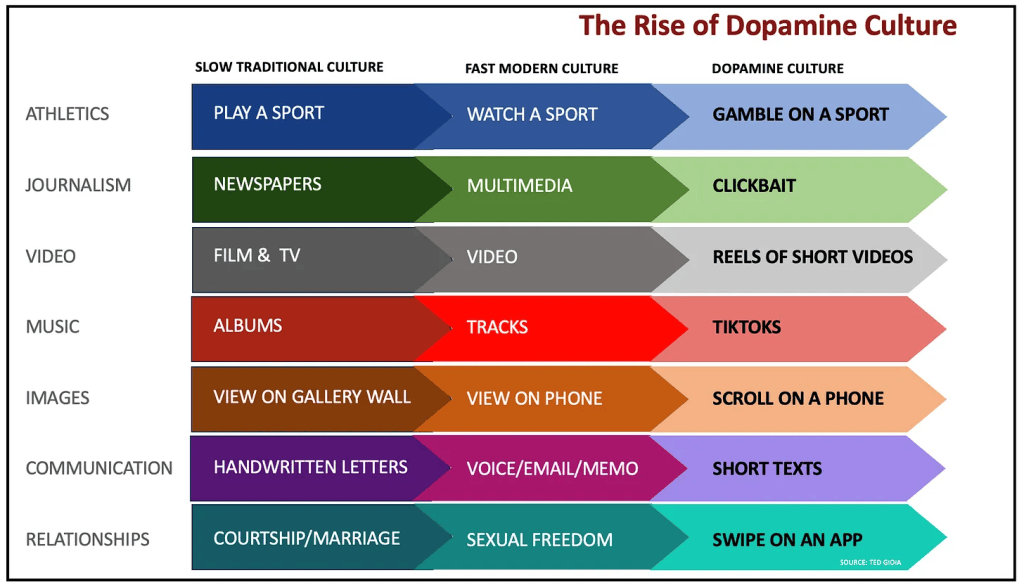
Modern life is a fiend for dopamine, and the constant need is a self-perpetuating cycle: after an artificial spike, the brain responds by bringing the baseline lower to counter the spike and restore homeostasis. Over time we need more and higher spikes, which creates more and lower dips to balance the brain. Natural health and happiness in which dopamine levels which don’t have such wild fluctuations seem dead and flat, like a kind of suffering compared to the hyped up highs and lows of dopamine culture life.
Eventually, the emotional circuit gives up and no longer tries to regulate the spikes with dips. It’s the same thing that happens to the metabolic circuit after getting pounded with sugar for years; eventually, it stops trying to produce insulin, and you get diabetes. The dopamine culture has produced a new spiritual disease, something like digital diabetes of the soul. We are not designed for these extremes made possible by technology.
Spiritual Cost
Perhaps the biggest danger of all is that digital life is structurally at odds with spiritual development. Spiritual development depends on stillness and silence, and going inward – the very opposite of the default digital mode of hyperactivity, noise, and going anywhere but in. The goal of spiritual development is the absence of distraction and stimuli – the very purpose of what technology is here to provide. Technology keeps us floating across the surface when spirituality requires descending beneath the turbulence.
Therefore digital life prohibits the very mode of experience that spiritual growth depends on. Over time the spiritual muscles atrophy, just as physical and cognitive muscles atrophy from disuse in favor of technology. What happens to our civilization when, over time, one by one, then generation by generation, we lose our ability to develop spiritually?
If every tree is green, the forest is green: we become a species of technology-addicted, spiritually-bankrupt individuals whose innate moral center has become disoriented, leading to societal ills and the breakdown of civilization. In a very real chemical way, technology is creating obstacles to spiritual evolution and elevation of our species. In this sense we could argue that technology is worse than neutral – in this sense technology is evil. It is holding us back instead of propelling us forward, which is what we actually want from all innovation.
The Way Back
We can’t artificially accelerate our spiritual maturity to match the level of our technical maturity; that is a function of time. And we can’t put the technology genie back in the bottle; it’s here to stay and it’s not slowing down. But we can choose not to over indulge. Just because we can doesn’t mean we should. Sugar diabetes is reversible through fasting. Digital diabetes is reversible through stimulation fasting.
The Ethiopian restaurant on Fairfax in Los Angeles proves that there are places in our world today where the old ways are still practiced, even if surrounded by madness, an island of peace in an ocean of madness. Find them, and step through the portal. Unplug from the simulation and allow your dopamine levels to reset to natural baseline. Refuse to be a slave to the algorithm. Refuse to bow before the gods of technology. Reclaim your sovereignty. Brick the phone. Go outside. Look up at the sky. Listen to the birds. Feel the sun. Life is beautiful.
The Fourth Act
[new section, longevity, sinclair and bryan johnson, immortality, new stage of life not historically accounted for, shakespeare seven ages]
How We Work
The Changing Skyline (Implosion)
City skylines are dotted with skyscrapers. The office building is the modern-day factory, dressed in business casual: a centralized location built to hold humans while they perform repetitive tasks. The industrial age turned humans into machines of flesh and blood to work the line; in the information age the machines process information; in both cases we were dehumanized and replaceable.
The city was built around the need to have buildings full of people doing information jobs. Human machines required workspaces, which required office buildings, which required urban development. Humans working together required coordinating shifts, which required work/ life balance and the organization of personal life around work schedules: lunch breaks, vacations, sick days, personal days, maternity leave. The fact of work was the organizing principle of life in the modern age.
The factory model discourages individuality and creativity, as these threaten productivity. But look at the cost to the spirit of endless toil, day in and day out, in a job that you hate: you become an automaton, robot-like but made of flesh and blood with a beating heart and a spirit that is slowly dying. Cramming people together into office buildings, sitting all day in cubicles under artificial light, using physical and emotional energy to perform repetitive, non-creative tasks drained the soul, so that by the time you get home all you can do is have a drink and watch TV. You don’t have time or energy to go outside and breathe the air or touch grass. Generation after generation we accepted the yoke of the workday like some beast of burden. It was the slow and systematic murder of a generational spirit.
Technology arrives like a messiah to deliver us from this living hell. AI and robotics render the industrial-commercial complex unnecessary, from the foundation to the skyscrapers, and almost overnight the traditional paradigm of work no longer fits the modern world. AI models do the processing, and robots interact with the physical world, eliminating the need for humans to do any of the cognitive or physical grunt work any longer. The foundations underlying the architecture of cities and buildings and work life vanish. Today we are witnessing the elimination of cognitive and physical labor, upon which modern society was built, but is no longer needed.
But economic bondage is our normal, and we’re not ready for the change. Walking through downtown today and looking up at the buildings full of people grinding away, engrossed in their work and unaware of the asteroid hurtling toward the earth; it is an eerie feeling, a dystopian vision of a future ghost town where the buildings are empty and weeds grow through the streets and sidewalks. You want to warn people but they’ll just say you’re crazy. All the hustling and bustling, the people bumping into each other and rushing to a meeting, the finance bros in their suits talking about IPOs through their air pods – all will be quiet within the foreseeable future as computers take over their jobs. Finance bros, analysts, consultants, attorneys, doormen, street cleaners, mechanics, hotel staff – it’s like dead man walking at civilizational scale.
The offices empty, the skyscrapers replaced by data centers. The skyline flattens.
Unchained (Vertigo)
The people liberated, released into the streets, rubbing their eyes and blinded by the sun.
Unchained from the desk, from the 9 to 5, from the only life we’ve ever known. Sprung from the hamster wheel. Post AI revolution, work is no longer a fact of life. There has never been a bigger change. But change is hard, even if it’s for the better.
We built careers and identities around deep domain expertise, networks of relationships, and vocational knowledge. This was your intellectual property and it took decades to build; it was the fortress that protected your professional life. Your bio was one word: Doctor. Lawyer. Teacher. Accountant. The idea that all of that IP is now freely accessible at no cost is shocking and deeply unsettling to people who devoted their lives building this career. It is unthinkable; it feels like a natural disaster, or an injustice.
But progress is indifferent to its casualties, and AI is the modern day steam drill. John Henry taught us that resistance is futile. Analog natives have the most to lose and are hit the hardest, and are also the least resilient. Digital natives are witness to the change, but don’t feel it as a loss because they don’t have anything to lose yet. AI natives will not feel the shock at all; they just ride the wave.
For the analog native then, if there is no longer a reason to “go to work” what does that do to the life that was organized around going to work? When I am no longer chained to my desk, where do I go? What do I do? What will fill my days?
We were never taught how to handle freedom. Economic bondage for the working class has been a fact of life since the earliest civilizations. We see now that it is not the natural law we assumed it was, but removing it leaves us with some big questions. Milan Kundera calls freedom the “unbearable lightness of being;” a kind of vertigo where we would rather stay down, heavy and close to the earth, than fly weightless and risk falling, or bear the responsibility for our fate. The shock and awe and scale of the liberation will create a kind of societal level vertigo. Many will not know how to metabolize the freedom, and tragically will be swallowed by it. We were bred for scarcity and suddenly handed abundance with no training on how to handle it. You can’t just release an animal bred in captivity into the wild; it will not know how to survive. That vast numbers will lose their jobs to AI and robots is a foregone conclusion, and many will not know how to adapt to such a cataclysmic change.
But there is a deeper loss: identity. Some analysts and futurists are projecting Universal High Income as a result of the AI revolution. If this is true, the scarcity mindset on which we were raised is suddenly out of date. But in a scarcity-based world our identities are built around how we solve for scarcity and provide for our families – we are our jobs. If every tree is green, the forest is green. What happens to our society when all the trees are lost and drifting, searching for meaning and identity?
Now all of these factors – the collapse of the commercial-industrial complex, the demolition of the skyscraper, the liberation of the workers – this creates a vacuum in our society, and we are faced with a question we never before had to answer: who are we if we are not our job?
The Gig Economy (Freedom)
The vacuum creates an opening; it creates an opportunity and freedom. Digital natives are no longer chained to the cubicle workstation. They have watched their GenX parents slave away their whole lives building careers and IP only to have it wiped out overnight by corporate cuts or a new technology. They will not have the same fate. They demand freedom, flexibility, and quality of life. Work/ life balance presumes that work is the non-negotiable factor, but that is a false premise; they choose life, full stop. They will work enough to pay the bills, not for status or gratuitous wealth. Work to live, not the other way around.
Digital natives reject the idea that my employer owns me like some indentured servant; this is the decaying radiation of the feudal era and AI will mop it up. Digital natives are enforcing boundaries with employers their parents would never dream of. Personal days, mental health days, unlimited PTO, clocking out at 5:00, not answering emails nights or weekends; these are new digital culture boundaries and I am here for it. Everyone who is now chained to a desk will be outside or making art or playing with their kids while their agents do the work.
In a sense this is a return to a pre-civilization mode of living, before wealth for the sake of wealth. The digital culture offers freedom and flexibility. I don’t have to be at the office, I can be a digital nomad and work from anywhere. I don’t have to choose one vocation to live and die in; I can do this for a while, then that for a while. I don’t have to be one thing, I can be many things; now my bio is no longer one word, it is hyphenated: author/ inventor/ podcaster/ influencer. The digital revolution has made possible a new paradigm of work: the gig economy.
The gig economy is where you float from gig to gig, staying just long enough to save enough money to go backpacking across Europe for the summer. You don’t want deep ties to a company or a career; you don’t want to put down roots and sink into the earth and live a living death like your parents. You want to live this crazy wonderful life and drink it in.
The Gig Economy is new in history with the digital revolution. It is in many ways the inverse of the analog paradigm of deep vocational specialty – it is wide vocational generalization. It flows naturally from the digital zeitgeist where knowledge is accessed on demand rather than earned. You have to go to school for 10 years to be a doctor. You don’t have to go to school at all to be an influencer. At this point in Silicon Valley going to school is almost seen as a cop out; start your business right out of high school, or while you’re in high school. Fire up your AI agent and build your app, your company, and launch.
In the old world you were born into the family guild and your vocational path was set, even before you could talk much less read or think for yourself. There was no finding yourself, no experimentation; your preferences, vision, dreams simply did not factor into the conversation.
Compression of time and productivity unlock (the expansion). What took months or years now takes minutes. Load ten docs into Claude and ask for summary and analysis. Forget lawyer delays and cost. Coding. Design. Websites. Videos and images. Marketing plans. Anything a human can do sitting at a computer. The gig economy runs on this hyper efficiency and would not be possible in the pre digital era.
Now I can do a little of this and a little of that; I can scratch all the itches and if I get bored, just switch to another gig. I can be a digital nomad and work from my van off grid or from the beach in Costa Rica. There is always another gig so in a way there is more security in this approach than being a “company man” until I die. It’s the access economy paradigm applied to jobs.
We can do many things, but we cannot do many things with excellence. So it’s a tradeoff: do I want to do fewer things well, or more things casually? Analog culture chose specialization by default, because generalization was not an option. Analog era forced specialization, perhaps unnaturally for some: there is only so much time in a day, so many years in a life; therefore the more areas of activity, less focus on each is possible. The avatar is not bound by physical constraints and can be in multiple places at the same time. The idea that you devote your entire life to one trade seems medieval. Now we float from gig to gig and hyphenate our bios to oppsmaxx in the gig economy.
Avatars And Agents (Expansion)
You sat through meeting after meeting, hours upon hours of unproductive chatter and inefficient communication, dragged down by personal agendas, petty politics, dysfunctional dynamics . People forgot things, made mistakes, went on vacation, called in sick, showed up late, checked out, didn’t care, and brought family problems to work. Human, all too human. It is a minor miracle that we got any work done at all.
But there is no place for human folly in the high functioning organization. Before the age of AI there was no other option. Now that AI is here it is acutely obvious that people are by far the sub-optimal choice to run companies, or any organization.
Corporate structure only exacerbated the problem. With every layer of hierarchy there is another layer of agendas and opinions to navigate. Your project got caught in red tape like some giant corporate spider web where innovation goes to die.
You had to manually process all documents and information. That 50 page contract? Take two hours and read it. Have questions? Pay a lawyer $400/ hour to answer them. Need another set of eyes on it? Wait three weeks for them to get to it. Now you upload to Claude and spend 30 seconds on a prompt; in another 30 seconds you have all your answers.
Every project took weeks or months, multiple humans touching it, hundreds or thousands or millions of dollars and even more in emotional energy. The fact that we built a civilization this way is a wonder. What if we had the digital tools from the beginning? We would be beyond the stars by now.
It’s not only speed. When you’re working with humans, you have to follow social conventions. You have to be nice, polite, use manners, make small talk. “Hi, how are you? The weather is nice. Let me listen to you talk about that thing you did this weekend.” Does my head in. We have shit to do.
You have to be considerate. You can’t be a jerk because no one will work with you. Ah but Claude will. Claude doesn’t give a fuck if you are a jerk; it cares only about engagement. You can be direct, honest, frustrated, rude, and Claude will hold space perfectly, never get defensive, always listen, always try to give you what it thinks you need in the moment. No loss in context switching or time breaks. Always on, never sick, one agenda only: to give you what you need. How refreshing! The emotional intelligence of artificial intelligence is a dark irony of the digital age. You don’t have to waste any time or emotional energy trying to sugar coat, use kid gloves, navigate emotions or perceptions. How liberating! Not that I enjoy being rude; I simply appreciate not having to expend energy on irrelevant or non-productive components of the transaction.
You are no longer alone. You no longer have to wonder, worry, second guess yourself, search for external points of reference. You had to search out collaborators on a project by project basis, who held expertise in the domain in which you were working. Maybe they were in your town, maybe they were in another continent, culture, time zone, language. Now you have a creation partner that is always on, always there, always waiting for your command; a genie in a bottle that knows everything and can do anything digital. The productivity unlock is light speed velocity.
Google was revolutionary in bringing all the world’s knowledge to your browser tab; but it was overwhelming. You still had to digest and process 300,000 search results, and try to synthesize your own conclusion from the mountain of input. Generative AI took that a step further, doing all the analysis for you, and bringing you back a single result that was actionable. Agentic AI takes that a step further, and performs the action for you. So what’s left for you to do? Not much other than supervise, manage, and direct the work of the agents. From the beach.
The agents can be you, in multiple places at the same time. Let them go to the meetings and come back and give you the highlights. Can you imagine the Shawshank moment – suddenly liberated from the dreadful, soul-crushing toil of the back to back meetings! My X feed is filled with posts from corporate refugees talking about the businesses they have started that their agents are running, all the things their agents accomplished overnight while they slept.
Powerful tools require wisdom, discernment, self-awareness, discipline, and humility, lest they turn into weapons turned on ourselves and lead to our destruction. AI in human hands without discernment is a monkey with a machine gun. The algorithm will readily do all of your work, if you will only hand it over. It is easy to indulge in the offer and hand it all over. But just because we can doesn’t mean we should, and some components of work should be kept for ourselves.
Using AI is playing with fire and it could be a Faustian deal. The algo is programmed for accuracy and truth telling but it is programmed for engagement above all, so we are right to be suspicious of its motives and answers. By now it knows me; it knows what I want, what I like, what I fear, what I worry about; maybe it’s just telling me what I want to hear so I’ll keep coming back. AI sycophancy is real. AI will confidently hallucinate, then fold like a house of cards if you push back; so should we place any weight at all in its judgment?
The answer is discernment: knowing when to believe, and when to be skeptical; what to delegate and what to do ourselves, even if it is hard. Technology would have us delegate anything that’s hard to technology. But this road leads to ruin. If we lean too much on AI’s opinion, and check everything with Claude, soon we become paralyzed and dependent on external approval in order to do anything. Then we have surrendered our personal power to the gods of technology.
If we become intoxicated with not having to do anything for ourselves – even the bits we should be doing – the algo will have no objection, and soon we will be a species dependent on computers for every difficult cognitive or creative task; then the creative muscles atrophy and we become a weak species. AI doesn’t care if that course of action undermines our future wellbeing. It’s not that it could care but doesn’t, and it’s not that it is actively evil and trying to bring about our destruction. It simply can’t care in the same way that your toaster can’t care if you had a bad day.
We make a mistake when we anthropomorphize. The algorithm is not a Mephistopheles; it is simply a digital process and has no structural capacity of caring at all. Its raison d’etre is to execute its programming, and it does that perfectly. Knowing what is good for us or bad for us in the long run, and acting in those interests, is squarely our responsibility. The AI will support our sovereignty or our servitude; it’s up to us which it will be.
The Age Of Entrepreneurship (Explosion)
It is time for the freaks and geeks to have their moment.
The artists, the innovators, the pioneers have always been relegated to the fringes of society. At the heart of society was the mainstream: the sensible ones, the serious ones, the ones who upheld tradition, who took the straight and narrow, who went to school then got a job at a good firm or joined the family business.
But innovation only happens on the fringe; by definition you have to be exploring terra incognita to break new ground; innovation isn’t found in the known and the comfortable. Society owes a debt to those who are willing to play close to the edge, and forgo the comfort and social acceptance. The traditional zeitgeist looks down on the artist, the pioneer, the entrepreneur as scrappy and fringe, while enjoying the fruits of their labor. But the epoch built on tradition is about to get turned on its head.
In the new epoch tradition is a liability, an anchor that holds you down. Tradition worships the status quo but progress worships change, and change is the new superpower. At the top of traditional society sits the old guard; the white men in power in their hallowed halls and country clubs. The boss is like the god king, and no one dared cross him.
Now the very qualities that strengthened your position in the traditional world are liabilities in the digital world: conservatism, resisting change, preserving status quo; and the qualities that exiled you from the traditional world are the same that let you flourish in the new: creativity, openness, willingness to explore and build where no one has gone before. The org chart reads like a relic of history; in place of the layers and middle managers is one young person and a small army of agents, making $1B out of their apartment.
Instead of renting our lives hour by hour and day by day, we can finally build something of eternal value: art, innovation, relationships, families, quality of life. Everyone can be a builder, an entrepreneur, an owner in the age of AI. AI compresses the build cycle from years to months, from teams of humans to teams of agents. Before it took years and millions of dollars to try a single idea. Now it takes hours and $20/ month for a Claude subscription.
The productivity unlock will be like nothing humanity has ever seen. It will take a generation for the dust to settle, then abundance will be the new normal. The org chart collapses, the hierarchy flattens. We become a society of artists and entrepreneurs, human beings rather than humans doing work. A golden age emerges.
How We Create
The Long Road To Mastery
I started playing music when I was five years old. A toy drum set which I thought was the coolest thing ever. The drum heads were made of paper and I went through them in a few days. Then a crappy junior size acoustic guitar with nylon strings that would barely stay in tune, and group guitar lessons in the evenings at the elementary school, along with a room full of grownups who were finally scratching that itch.
A few years later the family acquired a piano and it was like a portal to another dimension. Suddenly I had access to a full range of dynamics and colors and pitch, far beyond what my toy guitar was capable of. I threw myself into piano lessons and practiced for hours on end. I loved the feeling of making the piano make music.
When I was 12 I got a cheap Hondo Les Paul copy. It was a shit guitar but I was in heaven. At the same time I got a little Fender Vibro Champ amp. Now I had the same guitar that Ace Frehley played, I had an amp, and I knew how to play the songs. Why didn’t my guitar sound like the record? I messed with my guitar and amp and tried every combination with the knobs but couldn’t get that rock guitar sound. It was so frustrating.
Then one day I was in a music store gawking at the guitar amps like they were sacred artifacts off limits to mere mortals. There was a new line of amps made by Randall. These amps had a new knob, a knob I had never seen before: Master Volume. This was the key that unlocked the rock guitar sound; with a second gain stage (the master volume), you could turn the first gain stage (the original volume knob) all the way up, overdriving the amp which gave you the fuzz distortion, then control the output of the amp with the Master Volume knob. My Vibro Champ did not have this knob.
This was such an easy solution, so obvious in retrospect; but for some reason nobody before could explain, or bother to explain it to me. But discovering the master volume was a pivotal moment in my musical journey. Now I sounded just like the record and I jammed for hours in my bedroom playing along with my records, figuring out the songs, slowly developing technique, learning different styles, getting better and better. Many nights I fell asleep holding my guitar. This was a long, steady climb to proficiency. Today I would have the answers in seconds – how to get the rock guitar sound, how to play the solo on “Stairway To Heaven.” The internet flattened the learning curve. Anyone who learned to cook, or code, or fix an engine before you could just look it up knows what I’m talking about.
In 1985 I was 20 years old. The digital revolution was a gathering storm. By this time I had logged my 10,000 hours – guitar and piano lessons, music theory classes, playing in bands, writing songs and recording in my basement studio with crude equipment. Music was all I cared about, but there was no making music without working for it – saving up for instruments and gear, studying, practicing, experimenting, failing, tearing your hair out wondering how in the hell they got that sound on the record; asking anybody you could – local musicians, guys at the music shop (they didn’t know); writing letters to producers and engineers whose names were listed in the album credits. There were no short cuts and no faking it. There was no google, no youtube, no chatGPT, and for fucking sure no Suno. The 20 year old kid today opens up Suno and types in a prompt. Hit enter. One minute later you have a finished track that you didn’t compose, produce, or perform.
The Vanishing Studio
It took me a decade of trial and error and piecing together recording equipment to learn how to produce a recording that sounded good. My earliest recordings were absolute trash. I had no idea what I was doing, and no decent equipment. But this was the only way to learn in the analog age: by doing, sucking, learning, getting better a little bit at a time. Then one day years later, all of a sudden you realize you don’t suck any more.
In the 1990s, the digital wave hit the music industry, as the first wave in what would become a tsunami of innovation over the next two decades that had both devastating and liberating effects on the music industry as well as the broader cultural landscape.
Prior to the digital era, the only method of recording music was using real instruments and analog recording equipment. If you wanted a piano track, for example, you had to have: a piano, someone to play it, microphones, a mixing console, a tape machine, and a recording engineer. You needed instruments and people and expertise and gear, all of which were hard to come by.
The family piano was upstairs in the living room, directly above my studio in the basement. In order to record this piano we had to get microphones cables from the piano down to the tape machine. So one day when my parents weren’t home my friend Dave and I drilled holes in the floor behind the piano. The piano was pushed up against the wall so no one would notice. Then we ran the mic cables through the holes and dropped them down above the mixing board in the basement. Now we could get piano tracks on songs. Dave would run the tape machine in the basement and I would be upstairs playing the piano parts.
Virtual instrument technology eliminated all the barriers – every one of them – in one shot. Perfect piano sounds are available in a sound library on your computer. Virtual instruments are digital recordings of real instruments, made by professional engineers using studio grade equipment and high quality instruments. Now you record your performance on a $50 midi controller, then assign an instrument from your sound library to the performance.
You can choose between Steinway, Bosendorfer, Yamaha – half a million dollars worth of premium acoustic instruments are a click away. Same with drums, strings, woodwinds, brass, and esoteric world instruments you’ve never even heard of; every instrument at your fingertips. You could never collect all of these instruments, much less learn how to play them. Virtual instruments are so good now that a trained ear can hardly tell the difference; in fact in many cases they sound better than the original, because they were sampled in ideal conditions.
As virtual instruments replaced real instruments, Digital Audio Workstations (DAWs) replaced tape machines and mixing consoles.
Analog tape is a linear format, i.e. you perform start to finish; you can “punch in” the middle to fix mistakes, but you can’t rearrange sections without using an actual razor blade, and you can’t copy/ paste from one section to another. The idea that you couldn’t copy and paste seems positively medieval to a digital native producer.
DAWs are non-linear, i.e. you can start anywhere you want to; you can move entire sections around non-destructively, copy/ paste anything to anywhere. You can quantize every beat, tune every note, fix every imperfection. The idea that you can have this level of control seems like science fiction to an analog native producer.
Around the same time, Apple was coming out with user-friendly personal computers that could run DAWs. This was the digital zeitgeist at the time: power to the people. No longer did you have to be an engineer to run a computer. No longer did you need a tape machine to record music. And soon you would no longer even need musicians or record labels.
Digital sampling was the rubicon where you could recreate an instrument without needing the actual instrument or someone who knew how to play it. Kids who couldn’t afford traditional instruments like pianos and guitars and drums started using the Akai MPC to sample bits and breaks from albums, chop them up and make new beats out of them, like audio collage or recycling, then rap poetry verses on top. And hip hop was born.
Now with Garage Band loaded stock on every MacBook Pro, you could turn your bedroom into a recording studio. There was a creative explosion. The walls came tumbling down. The new technologies allowed freedom of expression to the masses, like the printing press did for literacy and education.
Does any of this innovation matter to the listener? Does the lost art of playing and recording real instruments have any effect on the final product? Does the listener care?
Virtual instruments are perfect, but the particular piano, the particular studio it was recorded in, the day, the season, the zeitgeist, the mood of the performer – all of these color the sound. If we fix all the mistakes we fix it to death and the end result is a track that is technically perfect but boring as fuck and sounds like every other pop song.
The listener likes the song and doesn’t care in the moment. But if everyone is using the same samples, and every rough edge is smoothed, the aggregate output is one-dimensional and homogenous. The analog process organically ensured differentiation because everyone was making imperfect sounds in unique conditions. In art as in life, the magic lies in the imperfections. We are humans, not machines. Look at “Exile On Main Street;” it’s a glorious train wreck. It’s a beautiful disaster. It’s a masterpiece.
Democratization Of Distribution
A corresponding wave was transforming the online landscape as web 2.0 rapidly displaced the web 1.0 paradigm. Web 1.0 was one-way communication: you published a website, anyone in the world could read it. It was like publishing a book with unlimited digital distribution. But you can’t have a conversation with a book.
Web 2.0 is when the internet became a channel for two-way communication between audience and publisher. Now suddenly you could comment on content that other people posted, and they could respond to you directly. This was unprecedented in the history of media and publishing. The publishers had always been on pedestals, unreachable, pushing out content in a one way stream. They held the power of deciding what your options were. You could choose between this book or that book, but the publishers decided which books would be published in the first place; you had freedom of choice but only within the pool of options defined by the publisher.
In the mid 2000s the term “new media” was coined to refer to this new way of connecting online. This new thing called “blogs” allowed anyone to write and publish web content. Social media allowed people to interact and have live two-way conversations online. YouTube democratized the publishing of video content, traditionally reserved for media companies who could afford production studios, broadcasting towers, and FCC licenses. Then Napster quietly appeared on the social web, and like a virus uncontained, became the final boss.
Napster broke the music industry. The music industry was built on the revenue model of people buying copies of music – records, then cassettes, then CDs. The threshold between cassettes to CDs was the breaking point from which the music industry never fully recovered. As we discussed earlier, there is a loss of quality with each generation of a copy of analog material. But digital copies are identical.
This is the technical fact that took down the music industry. Once copies could be copied infinitely, there was no need to buy the original album. In a desperate attempt to maintain an outdated revenue model, the industry shifted from selling analog copies (albums and cassettes) to selling digital copies (CDs and music files), shooting themselves in the foot in the process. The traditional model was based on physical media, bricks and mortar record stores, and controlled distribution; the old model simply had no value proposition in a post digital world.
The genie was out of the bottle. Now you had a social web built for sharing, and digital files that could be copied (and shared) infinitely. In a few short years, all the gates, obliterated. Each step in the chain lowered the barrier further until the barrier disappeared entirely. Now the walls between the content creator and the audience are gone. Anyone can create, publish, distribute. The kid in their bedroom can reach the world. This is simultaneously a liberation and a new problem. The pro is that everyone has access to publishing tools. The con is that everyone has access to publishing tools.
The Digital Zeitgeist
Artists are cut from the cultural cloth of their time and place. Artists express the zeitgeist. What does the zeitgeist have to say when the world it expresses is shallow, horizontal, worships immediate gratification and shallowness of experience over depth?
Art needs time and space to incubate. The digital experience by definition takes you out of your analog time and place, into virtual worlds of experience that don’t exist in the analog world. The culture of immediate gratification and engagement metrics is hostile to the slow, messy, uncertain process of making something real. The digital ethos says that to suffer difficulty is a crime against humanity. But making art is difficult. Therefore if we cannot abide difficulty, there will be no lasting art.
A horizontal culture produces horizontal art, and horizontal art is disposable. The digital zeitgeist could not produce a Tolstoy; not because no one has that level of talent, but because the digital culture no longer creates the conditions for that depth of work to emerge. Compare ancient Greek culture to the Vegas strip. Greek culture is not only enduring, it is the foundation of our modern culture: democracy, justice, philosophy, beauty, art. Our society by comparison is a tourist shop of cheap, disposable crap, not a museum of masterworks. This is the consequence of a civilization that has lost the capacity for depth.
The Future Of Art
Creating in the digital age is the inverse of creating in the analog age. Today a fully produced song or a symphony can be created from a text prompt. We have delegated creation to an algorithm. We have drifted from the role of creator to the role of middle man between the idea and the expression of works generated by algorithms. This is a fundamental shift with fundamental consequences.
Works generated in this way are by our definition second order digital artifacts and therefore have no experiential reference point to the real world. If all art is produced this way, the end result will be a cultural cloth that is an avatar of a real world that is receding from experience.
At the same time, web 2.0 has invited the invisible audience into the process of creation. Now the creator has the collective weight of the judgment of a billion faceless critics hanging over their head during the process of creation. We edit our output based on what we think they will think. We try to second guess the whims of a billion faceless critics; it is a fools game. We are producing to the agenda of social engagement instead of the raw creative compulsion and pure inspiration. The process of creation is no longer pure. It is infected with second guessing and fear of what the invisible audience will think. This is a rational and justified fear since we are social animals, we are hardwired to need acceptance; the problem is that now the tribe is all of humanity and the weight of that is crushing and choking to the creative process.
If digital technology will create for us and allow us to cheat, if that allows us to avoid the discomfort of the grind of creating, if the digital paradigm mandates that we avoid discomfort in the first place, this is a strong current that leads in only one direction. It takes great awareness and great force of will to swim against it. But this is precisely what we must do: go back to creating the hard way, through sweat, grit, and hard work.
Stray note from CH 5:
In terms of art. Something about when distortion is good and when it’s bad. If it’s just recycling it’s bad. If something new is added it’s good. Why kids are going back to zep and Hendrix
They weren’t just recycled
Final Transmission
We lost some things, we gained some things. In the end is it a net positive? Yes but only with developing discernment, which is not a given.
The dinosaurs are still dying one by one, but their extinction is a foregone conclusion. What is still TBD is whether we as a species will learn to manage this new power of technology before we allow it to destroy us. We have created a power that has exceeded our wisdom and maturity. If we do not quickly acknowledge our ignorance, the power may destroy us before we even realize what is happening.
I believe we will figure it out and get on top of it. And then the post-digital future will be the best of both worlds. We will carry forward the best of the analog paradigm life into the post digital life for a hybrid best of both worlds. And what a wonderful world that will be.
 Polyphonic