A Framework To Contemplate The Nature Of Knowledge and Reality
Another voice in the great conversation that has flowed through the ages from Socrates and Phyrro, through Montaigne and Hume, through classical and quantum physics to post-digital revolution.
- Absolute Versus Functional Knowledge
- Classes Of Reality
- The Nature Of Reality
- The Big Questions
- Objection And Answer
How can we know what we think we know? How can we be sure? In a grand stroke of dark irony, the answers to the biggest questions are unknowable. We can know what will happen if we mix hydrogen with oxygen. We can know that it’s 56 degrees outside, or that it’s Saturday. We know what happened yesterday.
But we cannot know what will happen tomorrow. We cannot know why we are here. And we cannot know if there is a god. That which we long to know more than anything, the deepest mysteries; this most fundamental, meta knowledge is off-limits.
Absolute Versus Functional Knowledge
Absolute knowledge is impossible. Who can guarantee that the sun will rise tomorrow? That water will always boil at 212 degrees? That E always = mc2. If science has taught us anything it’s that the more we know the more we realize we don’t know; the realm of the unknown grows in exponential proportion to the realm of the known. A true scientist will stipulate that everything is “for now,” until the next big theory or paradigm-busting evidence is discovered. Where does it end? When can we say, that’s it, we know all there is to know, there are no frontiers left to discover, the book of knowledge is complete. Obviously we can never say that. To make such a claim would be arrogant and unscientific. Socrates: “The only true wisdom is in knowing you know nothing.” Again, ironically, the only thing we can know for sure, is that we don’t know anything for sure.
But we can’t live this way. If absolute knowledge is off limits, then we must have some functional knowledge in order to go about our lives, we have to be “reasonably sure” in order to make plans. I can’t be absolutely sure that the sun will rise tomorrow, but I’m going to set my alarm because I am reasonably sure. I can’t be absolutely sure that water will boil at 212 degrees every time, but that uncertainty is not going to stop me from having my tea. Whether E = mc2 beyond the speed of light has nothing to do with the fact that rent is due.
Therefore whether we can ever claim absolute knowledge is irrelevant in terms of day to day living; absolute knowledge is only theoretical, where functional knowledge provides a framework for life. In this sense functional knowledge is more important than absolute knowledge; from a practical perspective we could say that absolute knowledge is not important at all. Nevertheless, as an introspective species capable of abstract thought, we are compelled to inquire and reflect on the nature of reality. As we go forward with our inquiry then let us disclaim in advance that when we speak of “knowledge” we mean functional and not absolute, as we have established that absolute knowledge is both impossible and irrelevant.
Classes Of Reality
All phenomena occur as one of three classes of reality: Objective Reality, Subjective Reality, and Quasi Reality. We shall define and discuss each in detail. A fourth, which is not so much a class of reality as it is a component of a theoretical framework to contemplate the nature of reality we shall call Non-Reality, referring to non-phenomenological propositions that are absolutely untrue.
Objective reality
Definition
Objective reality is that which is true regardless of any observer’s perspective.
Objective reality consists of phenomena that are observable, and verifiable by a third-party. The underlying nature of the phenomenon in question “is what it is” regardless of the observer’s perspective. Objective reality exists independently of the observer, and does not change as the observer’s perspective changes; objective reality is true regardless of the observer’s perspective. Objective reality can be known only by observation.
We will assert there exists an independent reality, in the sense that such a reality can be observed and verified by independent agents, i.e. agents that are independent of both the observer and the phenomenon in question. We will assert that a tree falls in the forest even if there’s no one around to hear it. We will assert that a world exists independently of any observer, human or otherwise.
Defining characteristics
- Is observable and verifiable by a third party
- Exists independently of the observer
- Does not change as the observer’s perspective changes
- True regardless of the observer’s perspective
- Can only be known by observation
Subjective reality
Definition
Subjective reality is a personal experience of an objective reality.
Subjective reality is that which is true for an individual observer in reference to a phenomenon which is objectively true. Subjective reality is a personal experience and is therefore not observable or verifiable by a third-party agent. Subjective reality does not exist independently of the observer i.e. does not exist but for the observer. Subjective reality changes as the observer’s perspective changes, is true depending on the observer’s perspective. Subjective reality can be known only by perception.
We could say that subjective reality is “less real” than objective reality in that its existence depends on an observer and an object; whereas objective reality is real on its own and does not depend on anything for its being. We could say that objective reality is a universal reality, whereas subjective reality is a personal reality that references a universal reality, a meta reality that is superimposed on an underlying reality.
Defining characteristics
- Is not observable and verifiable by a third party agent
- Does not exist independently of the observer
- Change as the observer’s perspective changes
- True depending on the observer’s perspective
- Can only be known by perception
Objective versus Subjective Reality
| Objective Reality | Subjective Reality |
| Observable and verifiable by a third party agent | Not observable and verifiable by a third party agent |
| Exists independently of the observer | Does not exist independently of the observer |
| Does not change as the observer’s perspective changes | Changes as the observer’s perspective changes |
| True regardless of the observer’s perspective | True depending on the observer’s perspective |
| Can only be known by observation | Can only be known by perception |
Quasi reality
Definition
Quasi reality is a personal experience of a non-reality, i.e. that which is true for an individual, but bears no relationship to objective reality.
Here is the realm of hopes, fears, wishes, dreams, and beliefs. Let us not conflate all cognitive and emotional phenomena with knowledge or reality. When cognitive phenomena are grounded in objective realities they qualify as subjective realities; when they are disconnected from objective realities they must be downgraded to quasi realities.
If subjective reality is “less real” than objective reality, we could say again that quasi reality is “less real” than subjective reality. Quasi reality is real for its perceiver but exists independently in the mind with no relationship to objective reality, whereas subjective reality at least references some objective reality. Quasi reality is a phantom. We could say quasi reality lies outside the boundaries of real phenomena. Quasi reality isn’t real, but it feels real.
The difference between subjective reality and quasi reality is a nuanced one, and unfortunately no one can say with certainty in which class a perceived reality lies; the distinctions are merely theoretical and allow us to engage in the game of philosophy.
Let us take beliefs as an example of quasi reality. A belief could be a subjective reality, or it could be a quasi reality, depending on whether the belief relates to objective reality or not. If I believe the earth is round, my belief aligns with functional scientific knowledge that the earth is round, therefore my belief qualifies as subjective reality, i.e. a personal experience of an objective reality (or as close as we can get to objective reality, which is functional knowledge). If I believe the earth is flat, my belief does not align with functional scientific knowledge, therefore my belief does not qualify as subjective reality, and must be classed as quasi reality, i.e. that which is true for an individual, but bears no relationship to objective reality.
A belief does not automatically qualify as subjective reality; a belief is merely a cognitive construct that references a possible reality. All actual realities are possible but all possible realities are not actual. A belief about a possible reality that is also an actual reality is a subjective reality. A belief about a possible reality that is not an actual reality is a quasi reality. Quasi realities are beliefs about possible realities that are usually either desired or feared. So we can say that subjective realities are cognitive phenomena that are based on objective realities and quasi realities are cognitive phenomena that are based on other cognitive phenomena (hope and fear); and all this time we are moving further away from absolute truth.
Other examples of quasi reality
- Hope
- Fear
- Dreams
- Intuition
- Imagination
- Anxiety
- Phobia
- Delusion
- Hallucination
Some of these could go either way – they could be either subjective or quasi realities as in the example above – e.g. hope, fear, dreams, intuition, imagination, anxiety, phobia – all of these could be either grounded in objective reality or disconnected entirely – this is the critical distinguishing factor that makes one of these cognitive phenomena either a subjective or quasi reality. But others could never be subjective reality, by definition of having no basis in objective reality – e.g. delusions and hallucinations. All are cognitive phenomena but all cognitive phenomena are not necessarily subjective realities. Quasi realities are cognitive phenomena attached to non-realities in the same way that subjective realities are cognitive phenomena that are attached to objective realities.
Non-reality
Definition
Non-reality is that which is untrue regardless of any observer’s perspective.
Non-reality is the other side of objective reality. Non-reality is not the presence of a false reality, it is the absolute absence of a true reality, the way black is the absolute absence of color. Non-reality is not dependent on an observer, it just “isn’t” where objective reality just “is.” 2 + 2 just does not equal five no matter who you are.
The Nature Of Reality
A gradient of truth
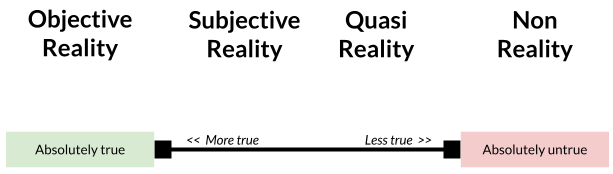
Phenomena exist on a spectrum of reality: toward one end of the spectrum, phenomena are “more true” therefore more real; toward the other end phenomena are “less true” therefore less real. At the far left lies Objective Reality, i.e. that which is absolutely true; at the far right lies Non-Reality, i.e. that which is absolutely untrue. In the middle lies Subjective Reality, a personal experience of an objective reality, and Quasi Reality, a personal experience of a non-reality.
Types of phenomena
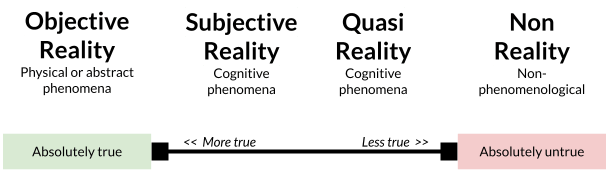
There are three types of phenomena:
- Physical: phenomena that occur in the natural world; e.g. light, heat, rain
- Abstract: phenomena that occur conceptually; e.g. shapes, math equations, ethical truths
- Cognitive: phenomena that occur in the mind; e.g. hopes, fears, beliefs
Objective reality consists of physical and abstract phenomena. Subjective reality consists of cognitive phenomena. Non-reality is non-phenomenological, that is there are no phenomena of any type that can occur in non-reality.
Universal versus personal experiences
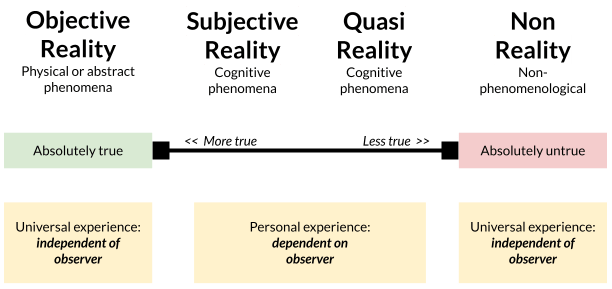
Objective reality is a universal experience, in the sense that, if it were possible for every observer to be free of distorting modifiers, they would all have an identical experience of an objective reality. 2 + 2 equals four, for everyone, no matter who you are. Subjective reality and quasi reality are personal experiences, in the sense that they are dependent on the observer, and are true only for the observer. Non-reality, like objective reality, is independent of any observer, in the sense that 2 + 2 never equals five, regardless of who you are.
The boundaries between classes of reality
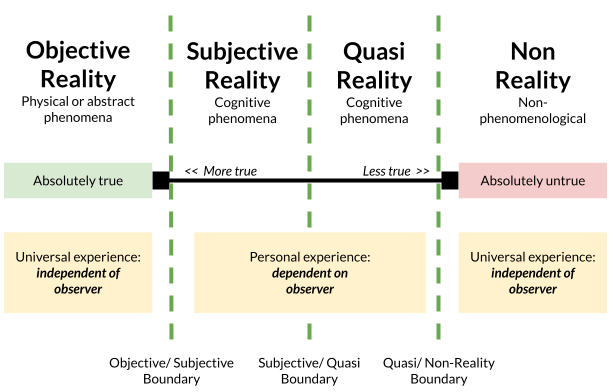
There are lines along the spectrum that separate the classes of reality from each other. The classification is mutually exclusive; all phenomena exist fully in one class or another; all reality is either wholly objective, subjective, or quasi. There are no degrees of objective reality or non-reality, while there are degrees of subjective reality; that is if a phenomenon is objectively real, it is no more or less real than any other phenomenon that is also objectively real. The same is true for non-reality. The two ends of the spectrum are more like blocks or points than gradients – a reality is either objectively true, or not.
There are, however, degrees of subjective and quasi reality, such that right over the objective/ subjective boundary, a subjective reality will be more real or more true than a phenomenon that is farther away from the objective/ subjective boundary. Likewise for quasi reality.
Mental health as a function of alignment between realities
The greater the degree of conformity or consistency between an objective reality and an observer’s experience of that reality, the greater the degree of mental health in the observer. The more an observer’s subjective reality aligns with, or is consistent with the objective reality in question, the greater degree of mental health in the observer. We can say that there is an inverse correlation between mental health and the presence of distorting modifiers – filters, biases, preconceived notions, beliefs, hopes, wishes, fears, etc. – any of these can distort the subjective reality of the observer. The greater the distortion, the less mental health. On the far left of the spectrum is perfect mental health i.e. the absence of distorting modifiers, where the observer sees reality as it is. On the far right of the spectrum is perfect mental illness i.e. the presence of so much distortion that the observer’s subjective reality has no connection whatsoever with objective reality.
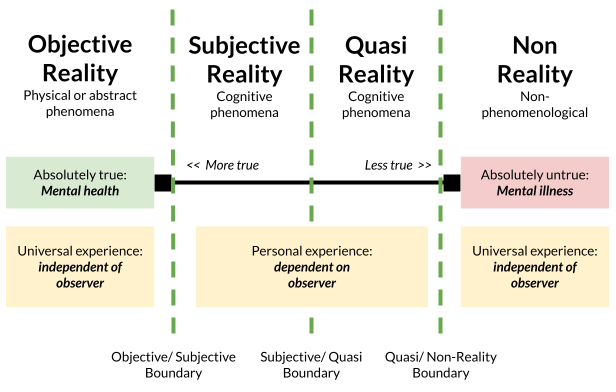
The smaller the discrepancy, the more mental health; the greater the discrepancy, the less mental health, all the way to hallucinations, schizophrenia, and a complete break from objective reality, where the subjective reality of the observer is not connected to observable reality whatsoever.
There is always a degree of distortion in the perceiving channel; distortion can never be zero; that is the subjective perception of an objective reality can more or less closely resemble the actual object, depending on the degree of distortion in the perceiving channel. When the discrepancy between the perception and the actual is smaller, there is less distortion in the perceiving channel, the channel is more clear, we can say there is a greater degree of health or mental health in this channel. When the degree of discrepancy between the perception and the actual is greater, there is more distortion in the perceiving channel, the channel is less clear, and we can say there is a lesser degree of health or mental health in this channel. When the perception is so distorted as to be detached entirely from objective reality, this is mental illness: still true for the perceiver and therefore must be granted some degree of reality, albeit the lowest form, and only one click away from non-reality.
Therefore mental health is the degree of alignment between subjective and objective reality. Mental health is the absence of distortion in the perceiving channel. Mental illness is a lack of alignment between subjective and objective reality.
The Big Questions
Therefore what is knowable and what is unknowable? Objective reality can be known by observation, and verified from any perspective. Subjective reality can only be known by individual perception. Using this framework, let us try to answer the big three.
What is the purpose of life?
Why are we here? Can we know the purpose of life? We can deduce there must be some purpose by virtue of existence itself, if we grant that nothing exists without a reason for existing, i.e. if there was no purpose for the existence of a thing, the thing would not exist. There is no thing that exists for no purpose, therefore everything that exists must have some purpose. Whatever the purpose of life, it is an objective reality, meaning it is observable and verifiable if the observer is granted the necessary perspective. This we do not possess as humans. This is an objective reality we cannot observe or verify due to limitations of our human perspective, therefore we cannot know. Further, the purpose of a thing can only be known by its maker; only the maker of a thing knows why they made the thing, i.e. what purpose is served by the existence of the thing. Since we did not make the universe or life within it, it is unknowable to us why the universe exists, or why life exists.
What is the meaning of life?
Purpose and meaning are two different things; purpose is knowable by the creator, but meaning is created by the individual. If we are not the cosmological creators of all life in general, we are at least the creators of our own lives, how we fill our days, how we respond to the thousand natural shocks that flesh is heir to. In this sense the meaning of our lives is ours to create and own.
Does god exist?
If by “god” we mean simply some entity that created the universe, using our framework of knowledge and reality, we say yes, such a god must exist, since we can observe and verify that the universe exists, since nothing can exist without having been created, and since anything created must have a creator.
If by “god” we mean the supernatural entity that embodies the traditional archetype, the question of this god’s existence is an inquiry into an objective (observable, verifiable) reality. This reality we cannot observe or verify, therefore we cannot know if it is true or not. We can believe, hope, doubt, or deny, but we cannot know. I can functionally know the sun will rise tomorrow, but I can only believe that this god exists. I cannot know, even functionally much less absolutely, that this god exists. In the hearts and minds of the faithful, belief feels like knowledge, belief is disguised as knowledge, and belief is mistaken for knowledge. But belief is not knowledge. I’m not saying this god does not exist. I’m not saying it does. I’m saying we can’t know. Which really sucks because of all the things there are to know, this is the one that we most long for. Almost makes one think, if it does exist, this is a cruelty on its part, to make its existence and nature unknowable to us.
Objection And Answer
Objection: we can know god by intuition and feeling, through non-rational means.
Answer: that doesn’t count. Intuition and feeling are quasi realities.
 Polyphonic